Don't Miss Out On Great Gains! - Best Investment Newsletter


Click for FREE sample of Kirk Lindstrom's Investment Letter

Don't miss out! Subscribe Now

google.com, pub-7001134751860982, DIRECT, f08c47fec0942fa0

Search For More

Showing posts with label US Treasuries. Show all posts

Sunday, October 15, 2023

Fed Funds Interest Rate vs S&P 500 Charts

 Fed Funds Interest Rate vs S&P 500 for 10/15/23


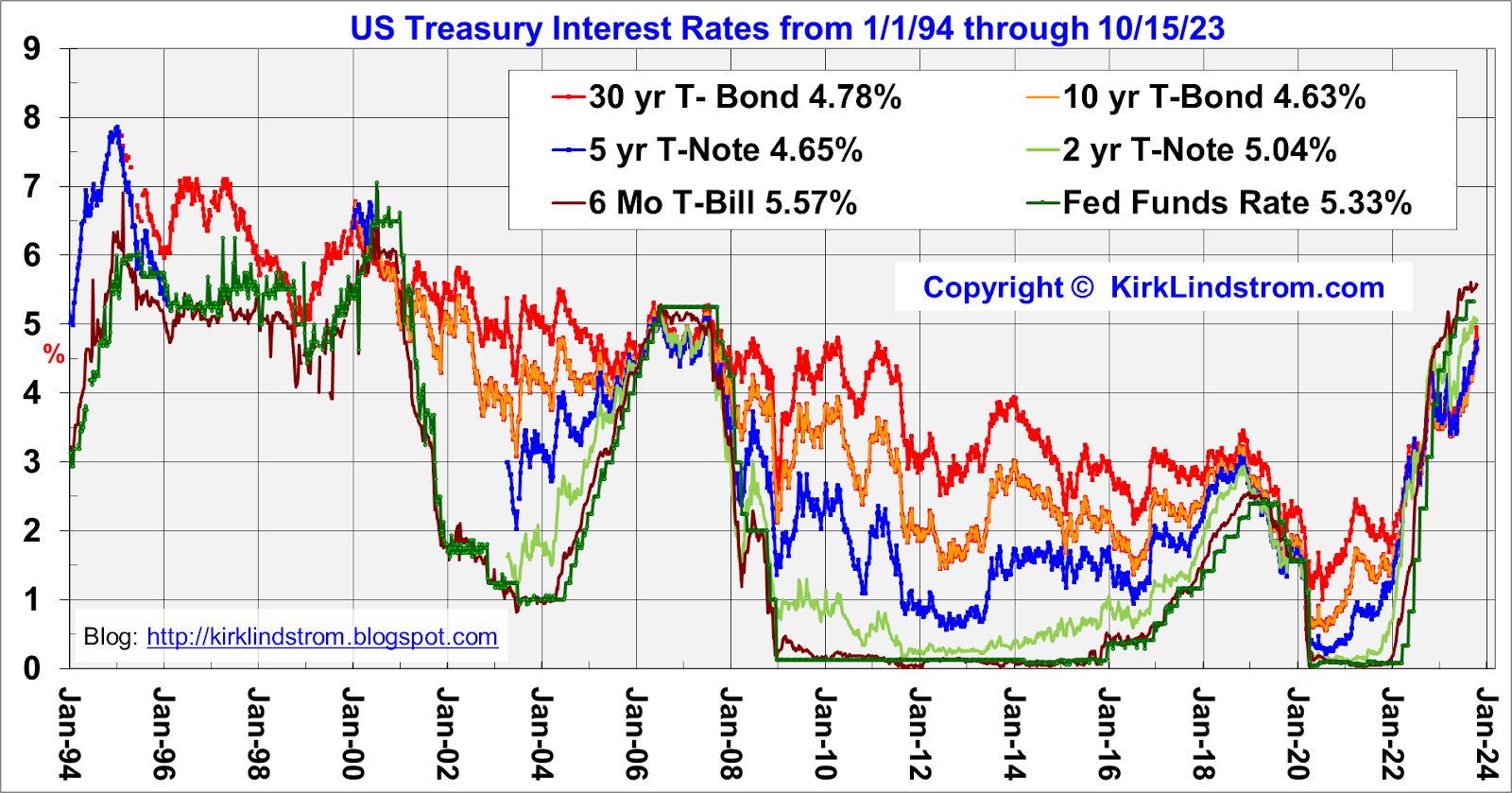
More Treasury Interest Rates


Kirk Lindstrom's Investment Letter

To see what stocks and ETFs are in my "Explore Portfolio" and get a full list of on my price targets to both take profits or buy more:
Subscribe NOW and get
the October 2023 Issue for FREE!!! 
(If you mention this blog post)

Kirk's Key Articles:

Tuesday, October 27, 2009

Bill Gross Predicts Low Inflation for Years

Monday Bill Gross, the manager of the largest US Bond fund PIMCO, said that the end to the Federal Reserve's debt buyback programs could add selling pressure to several credit markets, including U.S. Treasuries but he sees inflation remaining low for many years.

Quotes from a good Reuters article about Bill Gross:
"It's obvious that the programs in the United States, the Federal Reserve buyback programs ... those purchases and that purchasing power will cease within the next three to four months," Gross told CBC News Network.

"So, to the extent that that's gone, then perhaps the upward influence in terms of those longer-term Treasuries will be felt more strongly in the next several quarters."
Translated: Less demand for US Treasuries means interest rates will go up. Higher rates mean bonds and bond funds will lose some value. If rates go up a lot, perhaps due to high inflation or a dollar that continues to lose value, then foreign investors will be less inclined to purchase our debt, further pushing rates higher.

But Gross predicts very little inflation going forward:
"There's substantial excess capacity not just in terms of production but certainly in terms of employment," he said.

"That excess capacity will reduce the potential for inflation. We see inflation at zero to 1 percent for a number of years going forward."
IF I thought inflation would hold between zero and one percent for the next three years, then I'd believe US Treasuries, GNMA bonds and bond funds not indexed to inflation look like a good investment.

Mr. Gross is compensated for managing bond funds so it is in his best interest for everyone to think bond funds are a good investment.

Also, I believe Mr. Gross is a long-time democrat who supports spend, spend,spend and borrow, borrow, borrow here in CA and now in the US of A. He may not believe deficit spending leads to inflation because it weakens the US dollar which makes importing manufactured good and raw materials more expensive. Perhaps he believes our collective salaries will drop faster than the cost to import commodities and manufactured goods will go up.

Gross also said he believes emerging economies will grow faster than the U.S.
"The emerging world, whether it's in Asia, Australia or other associated countries, will do much better from the standpoint of growth, and that's where money should eventually move to. It moves there because of higher profits and it moves there actually because of higher real interest rates."

U.S. Treasury Rates for 10/27/09

TERM
MATURITY
DATE
CURRENT
PRICE/YIELD
3-Month01/28/20100.07 / .07
6-Month04/29/20100.17 / .18
12-Month10/21/20100.38 / .39
2-Year09/30/201199-31+ / 1.01
3-Year10/15/201299-12+ / 1.58
5-Year09/30/201499-17½ / 2.47
7-Year09/30/201699-05½ / 3.13
10-Year08/15/2019100-23 / 3.54
30-Year08/15/2039102-11+ / 4.36

(current Treasury rates at a Glance )

A share of Intel pays a 2.90% dividend and benefits from overseas growth with a product few can afford to compete with. I own Intel (INTC charts). Intel's dividend is better than a 5-yr treasury and Intel will benefit from emerging growth. Unlike a US treasuries, Intel will probably continue to raise its dividend.

I bought Intel for my personal account at a split adjusted price of $3.67 back in April 1993, 16.5 years ago. Today's dividend of $0.56 is like getting 15.3% on my original purchase. Unlike a US Treasury bond that returns the original investment when it matures, Intel is worth 545% more than what I paid for it. That is why I buy good stocks in growth industries for long-term inflation protection you don't get with Treasuries.

Disclaimer: I own Intel in my personal portfolio and I cover it in "Kirk Lindstrom's Investment Letter" (Free Sample) where I buy and sell it when price targets are reached.

More Information

Friday, October 23, 2009

Current US Treasury Rates

This table shows Current US Treasury Rates
Term
Date
Rate
3-Month Treasury
10/24/09 0.05%
6-Mo. Treasury
10/24/090.17%
1-Year Treasury 10/24/09 0.39%
2-Year Treasury 10/24/09 1.00%
3-Yr Treasury
10/24/091.57%
5-Yr Treasury
10/24/092.45%
7-Yr Treasury 10/24/09 3.10%
10-Yr Treasury
10/24/09 3.49%
30-Yr Treasury 10/24/09 4.29%

More at

With rates so low, banks will try to sell you their annuity products. Make sure you read our article: Beware of Annuities.


Wednesday, January 14, 2009

Current US Treasury Rates


Currently, the 30-year US Treasury rate is back under 3.0%.

More at US Treasury Rates at a Glance

The U.S. Treasuries Rates for Today are:

TERMCOUPONMATURITY
DATE
CURRENT
YIELD
3-Month0.00004/16/20090.10%
6-Month0.00007/16/20090.28%
12-Month0.00001/14/20100.43%
2-Year0.87512/31/20100 .73%
3-Year1.12501/15/20121.03%
5-Year1.50012/31/20131.36%
10-Year3.75011/15/20182.20%
30-Year4.50005/15/2038 2.91%

Tuesday, December 16, 2008

High Yield Fixed Income Investmets - Beware the Hype and Allure

When the Federal Reserve Fed Funds Rate was last at 1.0% several years ago, people everywhere were searching for yield, often with little regard for risk. [After today's rate cut, I suspect this will happen again.] I used to write for Suite101 at that time. I can't tell you how many times people asked me about high yield investments to get better return than "safe" treasuries and CDs. I often get emails today from my newsletter subscribers who think some new product might have better risk/reward than the safe investments I recommend for their core portfolios. For the lowest risk, I like US Treasuries when they are paying higher than current rates and CDs with FDIC. See My typical reply to questions is the higher the yield is above a US Treasury bond with the same term, the higher the risk (not counting CDs with FDIC which are also risk free.) Also, the increase in risk is not linear. If you get double the rate, you might be taking ten times the risk! I also wrote an article warning people about banks offering annuities with higher "teaser rates" so tellers had something to offer customers who complained about CDs renewing at very low rates. For the revised article, see:
Beware of Annuities
I also wrote an article telling people how to get better than advertised CD rates at their local bank. I've improved on this article over the years and you can read it here:
How to Get the Best CD Rates
Other people asked about investment products that paid eight to 12 percent a year returns that were related to real estate loans. As we have learned now, these products depended on people with low teaser rate mortgages paying the higher rates when the teaser period ended and their loans adjusted to very high rates, often nine percent or more. Very few would actually pay these high rates. They refinance or default in most cases. Anyone who bought these is probably very unhappy now as the return OF their investment is in doubt. They only wish they could have settled for low "returns ON investment" offered by treasuries five years ago.

The other investment to be wary of is high yield bond funds. These are often called "junk bond funds." I have NEVER liked these because your upside is limited by the interest rate compared to stocks which have unlimited upside. BOTH stocks and junk bond funds have the same downside which is bankruptcy for the company which makes the bonds and stocks nearly worthless. The bond holders usually get paid before shareholders with any assets available, but that is not much of a cushion for the average investor who was looking for 8% yield when treasuries were paying a few percent less.

Vanguard Fixed Income Funds:
  • GNMA Ginnie Mae Fund (VFIIX)
    • Seeks to provide a moderate level of current income.
    • Invests primarily in Government National Mortgage Association (”Ginnie Mae”) securities. These securities are backed by the U.S. government to provide timely payment of principal and interest.
    • Follows no specific maturity guidelines but typically maintains a dollar-weighted average maturity of 3 to 10 years.

  • TIPS or Treasury Inflation Protected Securities (VIPSX)
    • Seeks to provide investors inflation protection and income consistent with investment in inflation-indexed securities.
    • Invests in high-quality inflation-indexed bonds issued by the U.S. Treasury and government agencies as well as domestic corporations.
    • Maintains a dollar-weighted average maturity of 7 to 20 years.
    • Principal and interest payments are adjusted quarterly in response to changes in inflation.

  • Total Bond Fund (VBMFX)
    • Invests in more than 3,000 bonds representative of the broad, U.S. investment-grade market.
    • Goal is to keep pace with U.S. bond market returns.
    • Offers relatively high potential for investment income; share value tends to rise and fall modestly.
    • More appropriate for medium- or long-term goals where you’re looking for a reliable income stream.
    • Appropriate for diversifying the risks of stocks in a portfolio.

  • High-Yield/Junk Bond (VWEAX)
    • Seeks high current income.
    • Invests in lower- and medium-quality corporate bonds (“junk bonds”).
    • Fund’s bond holdings are considered speculative because of their issuers’ lower credit ratings, and they can fluctuate substantially in price.
    • Assesses a 1% redemption fee on shares held less than one year to discourage short-term trading

Vanguard Funds
NameSymbol
YTD Returns
as of
12/16/2008
Yield
500 Index Fund
VFINX 2.87%
–36.42%
GNMA Fund Investor Shares
VFIIX 4.71%
6.81%
High-Yield Corp Fund
VWEHX 13.90%
–28.00%
Inflation-Protect Sec
VIPSX 3.45%
–2.96%
Total Bond Mkt Index
VBMFX 4.56%
4.14%


Personally, I own the first three bond funds but not the last, Vanguard's High-Yield/Junk Bond (VWEAX). I much prefer to take my market risk with equities in both my core and my explore portfolios.


Followers - Click "follow" to get an email alert for new articles

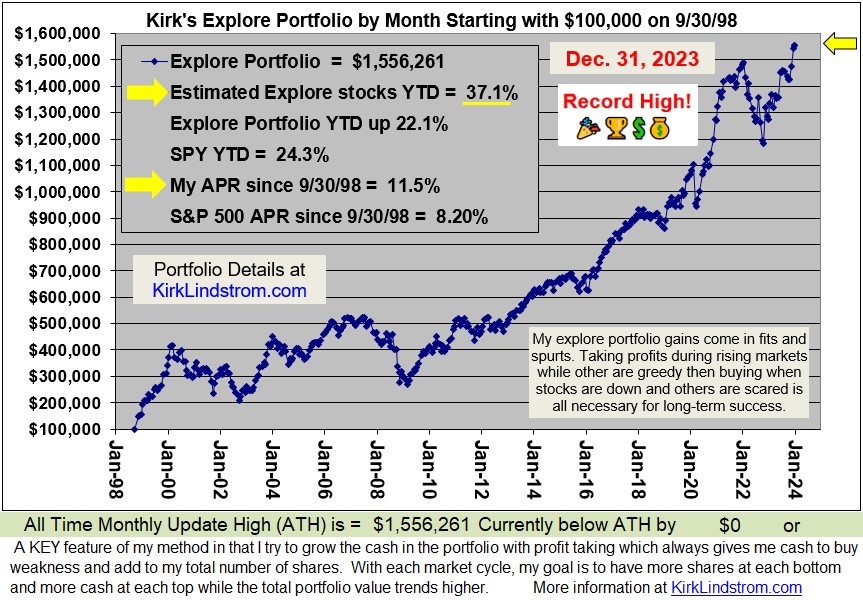
Kirk Lindstrom's Investment Letter Performance