Don't Miss Out On Great Gains! - Best Investment Newsletter


Click for FREE sample of Kirk Lindstrom's Investment Letter

Don't miss out! Subscribe Now

google.com, pub-7001134751860982, DIRECT, f08c47fec0942fa0

Search For More

Showing posts with label INTC. Show all posts

Wednesday, April 20, 2016

INTC - Intel Tests Support

Intel Charts - Golden Cross

These charts show Intel (INTC) making a bullish "Golden Cross" just after it traded down to touch it 50 and 200 day moving Averages.


I cover Intel in my newsletter:

Kirk Lindstrom's Investment Letter
Subscribe NOW 
and
get the
 
April 2016 Issue for FREE!


Tuesday, December 01, 2015

Santa Clause Rally!

Below are several charts showing the "Santa Clause Rally" that seems to be gaining steam. 

After buying the big decline a few months back, some stocks are already very, very close to taking profits already!


Santa Clause Rally! $SPY $SPX $LRCX $MSFT $GOOGL $INTC ChartsI sure hope nobody is missing out on all the fun as we are creeping back towards record highs again. Here comes Santa.....
Posted by Kirk Lindstrom's Investment Letter on Tuesday, December 1, 2015

This is my buy alert for LRCX on the most recent decline below $65.

Wednesday, September 02, 2015

Good News for Intel Stock - End of Inventory Correction

End of Inventory Correction is Good News for Intel Stock 

Intel (INTC Charts & Quote) has been in a bear market since the start of the year as it fell by 33% from $37.05 to the recent "Flash Crash Low" of $24.87.  Even though I own some shares dating back to my first purchase in 1993 when Intel was under $3, I feel very "Lucky" to have purchased more shares at $25 using money from taking profits when Intel was in the $30s. 

During the mini "Flash Crash" on August 24, 2015 I got some shares of Intel for $25.00 using a "Buy Limit Order" I had placed some time ago just for for this sort of event.  At $28.41 today, Intel is up 14% already.

Today we learned the good news that has helped Intel do much better than the market recently.

Inventory adjustments in semi industry coming to an end, says TSMC executive
Josephine Lien, Taipei; Jessie Shen, DIGITIMES [Wednesday 2 September 2015]

  • The recent inventory adjustments in the semiconductor industry have nearly come to an end, and the possibility is high for the industry to swing back to a seasonal growth cycle shortly, according to George Liu, director of sensor and driver business development at TSMC.
  • Companies and market analysts have been revising their outlook for the 2015 semiconductor market growth, due to weak market demand resulting in higher-than-expected inventory levels in the industry. Nevertheless, chipmakers are about to finish clearing out their excess inventory, said Liu.
  • From a long-term perspective, the semiconductor market will continue to expand along with the global economy and the ever-evolving consumer electronics market, Liu noted.
  • In addition, Liu suggested that it is premature to conclude that the global smartphone market growth has begun to slow. 


My guess is Intel was down with all US stocks as people were selling everything on August 24th and August 25th.  Some speculation was people had to sell good stocks like Intel to meet margin calls due to share prices tumbling in Asia, particularly Chinese stocks.


Using Auto Buy Limit Orders listed on the "Auto Buy/Sell List" on page five of my newsletter, we actually got one stock, FNSR (FNSR Charts & Quote), below the limit order buy price because the market gapped down on the open to fill our orders!  Below is an excerpt from what I sent my subscribers shortly after adding more Finisar shares to our portfolio. (Note, we also added Intel)

You hate to see people lose money, but I sure like the opportunity to buy their stocks at great prices when they are too scared to hold them.  Of course, I'll be happy to sell these shares to them when they are more excited about the future and the stock prices are much, much higher.


Thursday, July 23, 2015

New 3D Chip Technology From Intel & Micron

Intel (INTC), Micron (MU) or both?

Will this new 3D Memory Chip from Intel and Micron help Intel or Micron more?
Quick link to Article and Graphs


Intel, Micron or both?Will this new 3D Memory Chip from Intel and Micron help Intel or Micron more? I'm sure glad I...
Posted by Kirk Lindstrom's Investment Letter on Thursday, July 23, 2015

Friday, December 13, 2013

Will Google Build Server Chips & Threaten Intel's Profitable Business?

Today for smart, young adults just out of school Google (GOOG) is a great place to work much like HP (HPQ) was 35 years ago when I was hired. Back then, I went to HP to design semiconductors for the Optoelectronic group (OED). HP used its own chips in many of its own products. The group I went to invented the LED for their first calculators  released when I was in high school and the 1977 HP01 watch, released when I was at UC Berkeley studying electrical engineering and computer science.  
These advance products were part of what inspired me to study semiconductor engineering. 
(I get a kick out of how Apple(AAPL), Google and Samsung are still talking about getting regular folks to dress like geeks with wearable computing technology invented by HP and released as a product in 1977!) 

OED grew and spun off OCD (Optical Communication Division) where I designed fiber optic transceivers and later infrared (IrDA) transceivers when Bluetooth and WiFi were still too expensive so the industry used light to communicate wirelessly between devices.
Later chips went into HP computers and later PCs. Eventually, it was not cost effective so we sold the unit (mostly R&D) to Intel. One of my friends and neighbors still works at Intel designing advanced processes. I speculated that this was "cyclical" and eventually some companies would want more control of the chips and not rely on Intel or TSMC and bring both design and manufacturing back in house.

From Wall Street Breakfast at Seeking Alpha:

Intel threatened as Google mulls creating own server chips. Google ( GOOG) is reportedly thinking about designing its own server processors using technology from ARM Holdings ( ARMH). The idea is that with its own chips, Google could better manage the interaction between hardware and software. The move could hurt Intel ( INTC), which earns over 4% of its revenue from the search giant, and which has a 95% share of the market for server chips that use PC processors.
It is interesting that Google is now so big that they are contemplating doing their own chips. Will they also build their own fabs or have UMC, TSMC, Samsung or even Intel build the chips for them?


Kirk Lindstrom's Investment Letter
Don't Miss Out!
Subscribe Now

Get December Issue for Free!
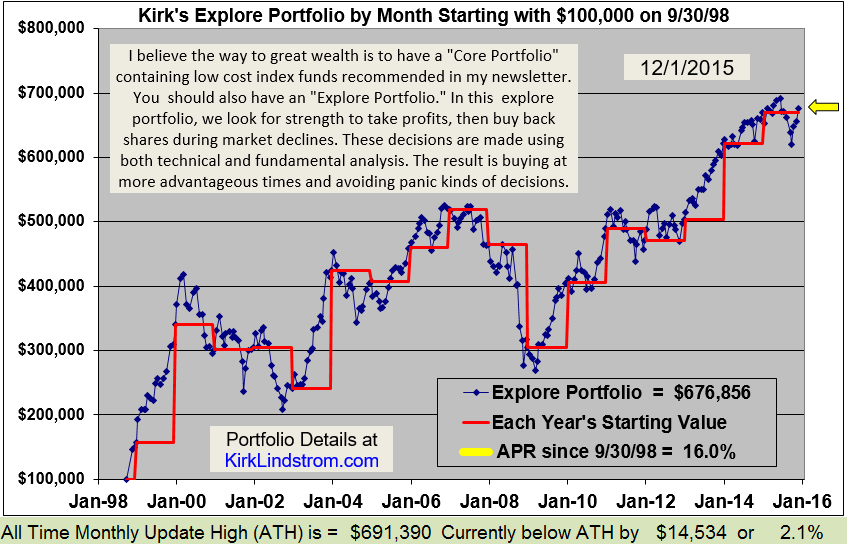
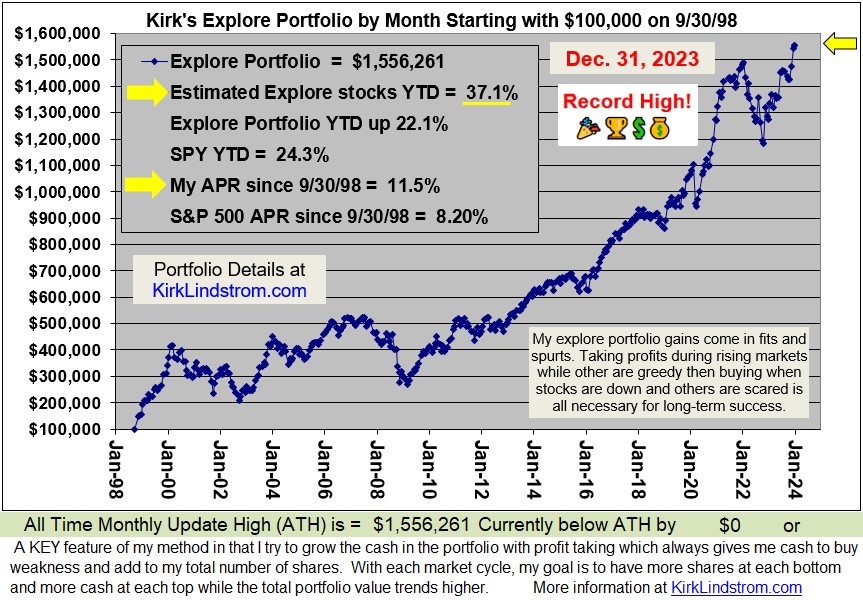
==>   My returns by year  &  New Record Highs <==
This table shows my newsletter "Core and Explore Portfolios" from 1998 through the end of Q3


Thursday, December 06, 2012

Jim Cramer is Bearish Intel and Why I Bought INTC

Update 7/29/13:

Now and then I like to watch Jim Cramer's "Mad Money" show on CNBC to see what direction the wind is blowing.  That is, I think Cramer has a very entertaining show, especially if you like shouting and nobody taking the other side of his arguments, but it seems he echos what is "group think" that tells you "why" a stock is up or down, but does very little for making good, long-term decisions.  Sponsors who sell trading strategies love his show as it is easy to sell stocks and advice for stocks that are moving.

On his October 28, 2012 show during the "Lightning Round" he gave a bearish call on Intel:
Intel (INTC): "During the period when it was doubling and doubling again, I was behind it, but I have walked away from it. INTC has a good yield, but it has no product used by mobile to speak of, except their own, and that isn't doing so well. INTC is stuck in the world of the PC, so even though it has a good yield, I say 'don't buy."
Two weeks later, on November 11, 2012, I bought shares for my personal account at $20.06.  I also increased the "Auto buy at $19.75" price target in my newsletter for my "Explore Portfolio" to anything under $20.25 to take advantage of any price weakness.

Late last month, on November 21, 2012,during the "Lightning Round" Cramer again gave a bearish call on Intel:
Intel: "I’m not going to tell someone to sell this stock with a 4.6% yield. I am going to say wait until it goes to 4% for a bounce, because I do believe the yield will support it, but I don’t see any reason why you should own it. Sell it only after a bounce when the yield drops to 4%."
Yesterday I heard him trash talk Intel again on the "Morning Bell" show by saying Intel should have used their cash to buy Arm Holdings (ARMH) when Arm was cheap. I couldn't have disagreed more. That motivated me to write this article saying why I disagreed:

Why Intel is a Great Buy (while at $19.75).  Excerpts
  • I bought my first shares if Intel in April 1993. At a split-adjusted price nearly 10 times what I paid for those shares, I believe Intel is a safer, more compelling buy now than it was in 1993.

Intel Since Inception
  • Yesterday, Dec. 4, 2012, Intel announced the largest bond sale in its history to buy back stock. This offering was 20% larger than its $5 billion similar offering in September 2011.
  • Wise investors will take advantage of low prices now to buy before tax loss selling ends and Intel uses these funds to repurchase shares.
  • I think Intel did something far better than buying ARM. Intel invested billions in new semiconductor equipment to build products with better performance than anyone can get from ARM chips running on competing processes.
  • Summary 
    Intel is a great buy here, especially under $20. Intel's valuation numbers will improve as they buy back shares with the funds from its just announced $6 billion bond offering. I took profits at $27.25 in February of this year with my newsletter explore portfolio, but now I am buying back. 
  • I would not be surprised to be taking profits in some of the Intel stock I've bought recently right around the time when TV gurus jump on the Intel bandwagon again next year. Jump on now and get a good seat!

Yesterday Intel closed at $19.85 and now it is over $20.


Was yesterday the last chance to buy Intel under $20?  I didn't mention in in my Seeking Alpha article, but I think Intel will probably build chips for Apple (AAPL) in the near future. By the time that is public knowledge (ie Intel chips showing up in tear-downs of Apple products) the stock will probably be $30 and then Cramer will change his tune.


More articles by Kirk Lindstrom at

Tuesday, June 08, 2010

ARMH: Jim Cramer likes Arm as "The Next Intel"

Update 7/29/13: Calling ARMH "the next Intel" Jim Cramer Likes Arm Holdings
Yesterday on Jim Cramer's Mad Money TV Program Cramer called Arm Holdings (ARMH Charts) "the next Intel" (INTC Charts) because its microprocessors are more energy efficient than Intel's. Cramer said ARMH is in 95% of all smartphones and MP3 players. Jim said Arm gets 75¢ in royalties for every iPad sold which makes it a great play on Apple (AAPL Charts).
Click chart for full size image courtesy of stockcharts.com

What Cramer didn't say is they are "more energy efficient" because they are slower and don't do as much. The new Intel "core i7" powered desktop computer I am writing this on has hyper threading and four cores so it effectively has eight processors working at the same time on up to eight different tasks. Of course this will use much more power than an MP3 player that just plays one song or video at a time.
Mariam Metsinger reported:
Arm Holdings had an amazing analyst day last month when it reported its total addressable market is expected to double to 29 billion chips in 2014 from 15 billion in 2009. The company could get significant pin action from Microsoft (MSFT charts), as its next generation of Windows is likely to operate on ARM-based processors. ARMH is also diversified into other areas, and its technology is used in sensors, smart meters and hard drives.


While ARMH's multiple is 31, this is reasonable, considering its growth rate is 22%. Cramer would buy the stock when it pulls back 2 points from where it was Monday to $10.
A PE of 31 with a growth rate of 22% is a PEG of 1.4.   I would not call it "a good value" (good value is when growth rate exceeds PE for a PEG under 1.0) but this PEG is not "unreasonable"  as long as growth continues above 20%.  It is easy to grow a small market but once it is large, growth slows as others want a piece.

I would think once the market is large enough, Intel could enter with its own low power chip such as its low cost Atom processor now used in low cost netbooks. Also, as the market matures, Apple could design their own chips and have them made at a foundry so they could keep the profits themselves rather than give them to ARMH. In fact, I would not be surprised to see Apple eventually go to a foundry build their own chip around Intel's atom processor where I believe the license fee to Intel could be less. They may use this to pressure Arm to lower prices. One thing for sure, it can be dangerous investing in companies with few products and customers as a large customer could go elsewhere for lower prices or more performance.

Finally, as users demand more functionality and multitasking from their portable devices, this will favor Intel and AMD with their multiple processors on a single slice of silicon. As the market for these devices get large enough for Intel to notice, I expect to see Intel (and probably AMD) release versions of their microprocessors optimized for low power rather than blazing speed. ARMH may continue to do well for years, but it is not without its risks.

More information:
Disclosure:  I own Intel and Microsoft in my personal portfolio.  I purchased Intel and Microsoft in 1993 at $3.67 and $2.43 per share, respectively.  I also cover both in K"irk Lindstrom's Investment Letter" and currently hold positions in both for the "Explore Portfolio."


Tuesday, October 27, 2009

Bill Gross Predicts Low Inflation for Years

Monday Bill Gross, the manager of the largest US Bond fund PIMCO, said that the end to the Federal Reserve's debt buyback programs could add selling pressure to several credit markets, including U.S. Treasuries but he sees inflation remaining low for many years.

Quotes from a good Reuters article about Bill Gross:
"It's obvious that the programs in the United States, the Federal Reserve buyback programs ... those purchases and that purchasing power will cease within the next three to four months," Gross told CBC News Network.

"So, to the extent that that's gone, then perhaps the upward influence in terms of those longer-term Treasuries will be felt more strongly in the next several quarters."
Translated: Less demand for US Treasuries means interest rates will go up. Higher rates mean bonds and bond funds will lose some value. If rates go up a lot, perhaps due to high inflation or a dollar that continues to lose value, then foreign investors will be less inclined to purchase our debt, further pushing rates higher.

But Gross predicts very little inflation going forward:
"There's substantial excess capacity not just in terms of production but certainly in terms of employment," he said.

"That excess capacity will reduce the potential for inflation. We see inflation at zero to 1 percent for a number of years going forward."
IF I thought inflation would hold between zero and one percent for the next three years, then I'd believe US Treasuries, GNMA bonds and bond funds not indexed to inflation look like a good investment.

Mr. Gross is compensated for managing bond funds so it is in his best interest for everyone to think bond funds are a good investment.

Also, I believe Mr. Gross is a long-time democrat who supports spend, spend,spend and borrow, borrow, borrow here in CA and now in the US of A. He may not believe deficit spending leads to inflation because it weakens the US dollar which makes importing manufactured good and raw materials more expensive. Perhaps he believes our collective salaries will drop faster than the cost to import commodities and manufactured goods will go up.

Gross also said he believes emerging economies will grow faster than the U.S.
"The emerging world, whether it's in Asia, Australia or other associated countries, will do much better from the standpoint of growth, and that's where money should eventually move to. It moves there because of higher profits and it moves there actually because of higher real interest rates."

U.S. Treasury Rates for 10/27/09

TERM
MATURITY
DATE
CURRENT
PRICE/YIELD
3-Month01/28/20100.07 / .07
6-Month04/29/20100.17 / .18
12-Month10/21/20100.38 / .39
2-Year09/30/201199-31+ / 1.01
3-Year10/15/201299-12+ / 1.58
5-Year09/30/201499-17½ / 2.47
7-Year09/30/201699-05½ / 3.13
10-Year08/15/2019100-23 / 3.54
30-Year08/15/2039102-11+ / 4.36

(current Treasury rates at a Glance )

A share of Intel pays a 2.90% dividend and benefits from overseas growth with a product few can afford to compete with. I own Intel (INTC charts). Intel's dividend is better than a 5-yr treasury and Intel will benefit from emerging growth. Unlike a US treasuries, Intel will probably continue to raise its dividend.

I bought Intel for my personal account at a split adjusted price of $3.67 back in April 1993, 16.5 years ago. Today's dividend of $0.56 is like getting 15.3% on my original purchase. Unlike a US Treasury bond that returns the original investment when it matures, Intel is worth 545% more than what I paid for it. That is why I buy good stocks in growth industries for long-term inflation protection you don't get with Treasuries.

Disclaimer: I own Intel in my personal portfolio and I cover it in "Kirk Lindstrom's Investment Letter" (Free Sample) where I buy and sell it when price targets are reached.

More Information

Saturday, July 25, 2009

NASDAQ Short Interest - Largest Positions and Changes

Yesterday Reuters reported short interest on the Nasdaq rose 4.1% in mid-July, reflecting an increase in bearish sentiment in the stock market.

Below are data and charts for the five Nasdaq stocks that experienced the largest increases and decreases in their short positions in the first half of July. Also included are data and a chart for the five largest NASDAQ short positions as of July 15, 2009.
FIVE BIGGEST INCREASES:
COMPANY July 15 June 30 NET CHANGE %CHANGE
-------------------------------------------------------------------
E*Trade Financial(ETFC) 135,357,993 95,942,774 39,415,219 41.08
Cell Therapeutics
(CTIC) 31,428,479 14,244,326 17,184,153 120.64
Evergreen Solar (ESLR) 30,912,624 22,979,653 7,932,971 34.52
Applied Materials(AMAT) 54,661,221 47,382,033 7,279,188 15.36
Starbucks Corp (SBUX) 48,176,793 41,999,418 6,177,375 14.71

Click Chart courtesy of stockcharts.com for full size image

FIVE BIGGEST DECREASES
COMPANY July 15 June 30 NET CHANGE %CHANGE
-------------------------------------------------------------------

Sirius XM Radio (SIRI) 146,038,635 194,820,020 -48,781,385 -25.04
Sanmina-SCI Corp (SANM) 1,771,396 11,172,618 -9,401,222 -84.15
Intel Corp (INTC) 79,599,664 88,709,534 -9,109,870 -10.27
Level 3 Comm Inc (LVLT) 101,482,009 109,950,552 -8,468,543 -7.70
Finisar Corp (FNSR) 1,200,475 8,521,489 -7,321,014 -85.91
Click Chart courtesy of stockcharts.com for full size image

FIVE BIGGEST POSITIONS:
COMPANY July 15 June 30 NET CHANGE %CHANGE
-------------------------------------------------------------------

Sirius XM Radio (SIRI) 146,038,635 194,820,020 -48,781,385 -25.04
E*Trade Financial(ETFC) 135,357,993 95.942,774 39,415,219 41.08
Level 3 Comm Inc (LVLT) 101,482,009 109,950,552 -8,468,543 -7.70
Microsoft Corp (MSFT) 80,868,407 86,848,410 -5,980,003 -6.89
Intel Corp (INTC) 79,599,664 88,709,534 -9,109,870 -10.27
Click Chart courtesy of stockcharts.com for full size image
Questions for the SEC and Congress:
  1. Why is there a nine day delay in making the data public?

  2. Why is this data not made available in real time or at the end of each trading day?

  3. Who has access to this data before the public and are they allowed to trade on this undisclosed to the public information?

  4. If anyone who is allowed to trade on the information, then what happened to enforcing Regulation FD that limits selective disclosure and insider trading?
If ANYONE has access to the data to make these calculations, then I think it is criminal that this data is not made available as soon as available to everyone.

Disclaimer: I own in my own portfolio and cover in "Kirk Lindstrom's Investment Letter" AMAT, FNSR, INTC and MSFT. I may buy or sell at any time without announcement beforehand.


Followers - Click "follow" to get an email alert for new articles

Kirk Lindstrom's Investment Letter Performance