Don't Miss Out On Great Gains! - Best Investment Newsletter


Click for FREE sample of Kirk Lindstrom's Investment Letter

Don't miss out! Subscribe Now

google.com, pub-7001134751860982, DIRECT, f08c47fec0942fa0

Search For More

Showing posts with label ECRI. Show all posts

Friday, February 10, 2023

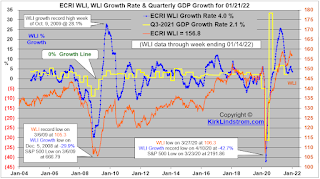
ECRI's WLI, WLI Growth Rate & Quarterly GDP Growth Graphs

ECRI WLI, WLI Growth Rate & Quarterly GDP Growth for 2/10/23


ECRI Recession & Inflation Calls:

Feb. 9, 2023 FACE Interview: Lakshman calls the pullback in inflation The Immaculate Disinflation.
"Lakshman is calling the pullback in inflation ,"The Immaculate Disinflation. He is still expecting a hard landing from last June's forecast."

Jan. 13, 2023 Don't Be Fooled, A Recession Really Is Coming


Lakshman is the co-founder of the Economic Cycle Research Institute and has more than 30 years of analyzing business cycles under his belt. Lakshman and Matt talk about the recent market volatility, inflation, and the Federal Reserve. They also cover why Lakshman thinks a recession could be coming from a cyclical perspective and whether the bond market could lead us out of a recession. 00:00 Stansberry Conference Overview 5:41 Lakshman's View on Current Markets 7:49 Peak Inflation & Fed Rate Hikes 11:12 Opportunities for Investors 15:09 Are We In a Recession? 20:49 When Will the Bear Market Hit Bottom? 22:58 Investment to Own for the Next 10 Years


Kirk Lindstrom's Investment Letter
To see what stocks and ETFs are in my portfolio and get a full list of on my price targets to both take profits or buy more:
 Subscribe NOW  and get
the
 February 2023 
Issue for FREE!!! 
(If you mention this ad)


Reminder, you can subscribe or follow this feed and get sent emails by Google when I post new charts and articles. Just click "Follow" below.

.

Friday, January 21, 2022

Saturday, September 01, 2018

ECRI Warns Elevated Risk of 10 to 20% Correction

Lakshman Achuthan, managing director at the Economic Cycle Research Institute or ECRI told CNBC yesterday that the US stock market is facing elevated risk of 10 to 20 percent correction.
Click for Full Sized Images
We ALREADY had a 12% decline  and the market is just pulling above its prior high.  
The stock market is part of ECRI's leading indicators so its new highs could also be signaling that ECRI's Weekly Leading Index (WLI) growth rate is about to bottom.  


Stock market facing elevated risk of 10-20 percent correction, economic forecaster says from CNBC.

So the question remains is a second decline over 10%  this year about to start? 

 Subscribe NOW  and get
the
 August 2018 
Issue for FREE!!!


Friday, January 13, 2017

ECRI's Weekly Leading US Index Up to a New Record High

The Economic Cycle Research Institute, ECRI -- a New York-based independent forecasting group, released its latest readings for its proprietary Weekly Leading Index (WLI) today.

For the week ending January 6, 2017:

  • WLI was 144.9 up slightly from the prior week's reading of 144.6
  • WLI Growth was 12.2%, up from the prior week's reading of 12.0%.
Here is my chart of weekly WLI and its growth rate compared to quarterly US GDP back to 1994:

Chart of WLI and WLI growth vs GDP Growth (click charts to expand)

This is ECRI's chart showing WLI's weekly growth rate back to 1974:
Weekly ECRI Press Release Graph


Weekly ECRI vs the S&P500 and GDP Growth
Newsletter Special!
Subscribe to my Newsletter NOW
and get the January 2017 Issue for FREE!!


Notes:
  1. Occasionally the WLI level and growth rate can move in different directions, because the latter is derived from a four-week moving average.
  2. ECRI uses the WLI level and WLI growth rate to HELP predict turns in the business cycle and growth rate cycle respectively. Those target cycles are not the same as GDP level or growth, but rather a set of coincident indicators (including production, employment income and sales) that make up the coincident index. Based on two additional decades of data not available to the general public, there are a couple of occasions (in 1951 and 1966) when WLI growth fell well below negative ten, but no recessions resulted (although there were clear growth slowdowns).
  3. For a better understanding of ECRI's indicators, read their book, "Beating the Business Cycle: How to Predict and Profit From Turning Points in the Economy
ECRI's Book

is Available on Kindle

Thursday, July 03, 2014

ECRI USFIG at 70-Month High - Inflation Pressures Continue Higher

On Thursday, July 3, 2014, the Economic Cycle Research Institute (ECRI), a New York-based independent forecasting group, released its latest readings for its proprietary U.S. Future Inflation Gauge (USFIG) for June 2014.  The value of the USFIG lies in its ability to measure underlying inflationary pressures and thereby predict turning points in the U.S. inflation cycle.

In today's release, July 3, 2014, ECRI reported USFIG rose to 105.5 in June from the May reading of 105.0.

Click for full sized images
Lakshman Achuthan,ECRI's managing director, said "With the USFIG trending up and hitting a 70-month high in June, underlying inflation pressures have risen further."

ECRI’s Recommended Books:

Tuesday, July 30, 2013

ECRI's Lakshman Achuthan Defends their Recession Call

July 30 (Bloomberg) -- Lakshman Achuthan, co-founder of the Economic Cycle Research Institute, talks about the U.S. economy. Achuthan speaks with Tom Keene and Sara Eisen on Bloomberg Television's "Surveillance." (Source: Bloomberg)
----------------------------------------------------------------

----------------------------------------------------------------

Highlights:
  • Job losses for 35 to 54 year olds are approaching one million jobs lost since this "recovery" began.  This is where you make and spend the most money and is at the core to what is wrong. 
  • If you are doing well, then in the recent economy you are doing very well.  If you are near Wall Street, then "it is good to be close to the helicopters which are spewing cash."
  • The Fed would "not have four years of zero interest rate policy and quantitative easing forever and Q-ternity if everything was OK."
  • "We believe a recession began last year."
  • "Sometimes it takes up to two years" for final GDP revisions which can be large.
  • Past downward revisions to GDP were 2 to 4 percentage points lower after the last few recessions.
  • The Fed is using "trickle down theory" of the "wealth effect" hoping higher stock and housing prices will stimulate the economy.
  • The pace of growth in home prices will decelerate. 
  • The current GDP data shows US growth is lower now than in Japan during their "lost decades."
Feel free to add any items I missed or you think is important in the comments.
Facebook Group "Investing for the Long Term"

Tuesday, April 30, 2013

Q1 GDP & ECRI Clarification on Recession Call

On April 26, 2013, US Bureau of Economic Analysis released its first estimate of real gross domestic product, GDP.
Real gross domestic product -- the output of goods and services produced by labor and property located in the United States -- increased at an annual rate of 2.5 percent in the first quarter of 2013 (that is, from the fourth quarter to the first quarter), according to the "advance" estimate released by the Bureau of Economic Analysis. In the fourth quarter, real GDP increased 0.4 percent. 
The Bureau emphasized that the first-quarter advance estimate released today is based on source data that are incomplete or subject to further revision by the source agency (see the box on page 3 and "Comparisons of Revisions to GDP" on page 5). The "second" estimate for the first quarter, based on more complete data, will be released on May 30, 2013. 
The increase in real GDP in the first quarter primarily reflected positive contributions from
personal consumption expenditures (PCE), private inventory investment, exports, residential investment, and nonresidential fixed investment that were partly offset by negative contributions from federal government spending and state and local government spending. Imports, which are a subtraction in the calculation of GDP, increased.
We had a good discussion of this release in my "Investing for the Long Term" Facebook group where many questioned how could ECRI think we are in a recession with 2.5% GDP growth.

 Lakshman Achuthan from ECRI posted the following comments:  (Text follows image)

Text for my articles


Lakshman Achuthan You're not alone in thinking our recession call was wrong. Still, the facts are that the GDP release on August 28, 2008 – with the economy eight months inside the Great Recession – revised Q2/08 GDP growth to 3.3% from 1.9%, up from 0.9% in Q1/08. But both of those data points, as well as GDP data for the first two quarters of the 2001 and 1990-91 recessions, were subsequently revised by 2 to 4 percentage points over time. This is how real-time data often behave during recessions.

Lakshman Achuthan Hardly any economists recognized the severe 1973-75 recession until almost a year after it started. Indeed, that recession began with the ISM at 68.1, and payroll jobs growth did not turn negative for eight months.

In 1970, unaware that the economy was nine months into recession, none other than Paul Samuelson said that the NBER had worked itself out of a job, meaning that improved policy expertise had made recessions very unlikely. http://www.businesscycle.com/ecri-news-events/news-details/economic-cycle-research-the-2012-recession-are-we-there-yet


www.businesscycle.com
Nine months ago we knew that, sitting here today, most people probably would not realize that we are in recession – and we do believe we are in recession.

Lakshman Achuthan Just to clarify, a recession is not defined by two successive quarters of negative GDP, rather it's a self-reinforcing downturn in economic activity, when a drop in spending leads to cutbacks in production and thus jobs, triggering a loss of income that spreads across the country and from industry to industry, hurting sales and in turn feeding back into a further drop in production - in effect a vicious cycle. 
http://money.cnn.com/2008/05/05/news/economy/recession/


money.cnn.com
Recession? Or just a slowdown? Some will tell you it doesn't much matter - that it's a distinction without a difference. Nothing could be further from the truth - or as dangerous a delusion.


Tuesday, March 12, 2013

ECRI Stays with Recession Call

ECRI made the rounds last week explaining why they still believe we are in a recession.  Below is a summary   from Sam of their appearances.

Interview Summary 
In a few interviews this week we discussed ECRI’s recent presentation, Recession in the Yo-Yo Years. Each interview clip covers different aspects of that presentation as described below. 

CNBC

  • Coincident indicators, including GDP, are consistent with recession starting mid 2012
  • Stock prices can rise during recession
  • Policy makers targeting market prices
  • Mild vs. severe recession
Bloomberg Part 1
  • The Fed's recessionary stall speed measure stalled in 2012
  • Year-over year jobs growth is slowing, not accelerating
  • Nominal GDP growth recessionary
  • ECRI April home price growth upturn call & recent Leading Home Price Index decline 
Bloomberg Part 2
  • Stocks prices and recessions
  • Fed targeting financial assets, including 401(k)s
  • Plunging velocity of money since 2011
  • ECRI April home price upturn call, and recent Leading Home Price Index decline 

Yahoo Finance
  • Weak incomes and recession
  • Stock prices have risen during three of the past 15 past recessions
  • The difficulty of “real-time” recognition of recession


Tuesday, July 10, 2012

ECRI Says We Are In A Recession

Lakshman Achuthan, co-founder of the Economic Cycle Research Institute (ECRI ) told Bloomberg today that he believes we are now in a recession. It has ALREADY started.
Watch the video and read my summary of Lakshman's comments at:

For more information, read:
Click to order their book
Book: Beating The Business Cycle
In 2004, Lakshman Achuthan co-authored "Beating the Business Cycle: How to Predict and Profit from Turning Points in the Economy"

Friday, February 24, 2012

ECRI Remains Bearish on US Economy - Recession Still Expected

Lakshman Achuthan, Co-Founder & Chief Operations Officer of the Economic Cycle Research Institute (ECRI - More about ECRI) appeared on CNBC this morning to discuss their economic outlook. The video is below.
In a nutshell ECRI remains bearish on the US economy with a continuing forecast for a recession. They believe economic growth doesn't really "muddle along" at sustained low rates.
Summary of Key Points:
Since September Recession Call, ALL of the data used to define recessions is slowing.
  • Year-over-year GDP Growth peaked in Q3 2010, fell to 1.5% in Q2 2011 and has been flat-line since then.
    (Annualized quarterly GDP growth for Q4-2011 was 2.8% but the year-over-year growth was only 1.6%)
  • Personal Income Growth and Broad Sales Growth see  Same kind of pattern
  • Industrial production at 22 month low
Put those into a COINCIDENT INDEX then it shows the growth has been slowing.  We have not had a decline like that in the Coincident Index without a recession in the last 50 years. 
Joe Kernan pointed out the Federal Reserve must agree with Lakshman and ECRI because they continue to print money and keep rates low.
  • Lakshman said World's central banks are printing money like crazy which is why we feel better.  If you look at how often money is exchanged in the economy, then it is at a record low in the US and Europe and near record lows in China.
  • Jobs have improved but that is a bit of a lagging indicator.  ECRI still feels jobs will get worse and follow consumer spending growth which is going down.  Personal disposable income has been negative for FIVE MONTHS!
Lakshman says recession should begin by mid year 2012.  He says revisions in the data might say a recession has already started just like the last recession.  If the recession is starting now, then the consensus should figure it out in about six months (August.)
==============================================
==============================================
Can anything change his mind?  The stock market seems to be predicting a recovery.
  • Leading indicators do not negate the recession forecast.  WLI is up but with the tons of money printed, they are surprised these are not up more.
  • The stock market rallied after their recession call in 2008 before it rolled over.  
Remember it was not until much later that revisions said the last recession started in late 2007.  Q1 2008 was the first quarter of negative GDP at -0.7%.  The data during that time was positive and the stock market thought we would have a recovery.
Revised GDP Q4-2007 to current Q4-2010

 For more information, read:
Click to order their book
Book: Beating The Business Cycle
In 2004, Lakshman Achuthan co-authored "Beating the Business Cycle: How to Predict and Profit from Turning Points in the Economy"

Monday, August 29, 2011

Friday, June 03, 2011

ECRI's US-FIG Down Again in May

The Economic Cycle Research Institute, ECRI, released its latest readings for its proprietary monthly Future Inflation Gauges this morning.  ECRI says the value of their U.S. Future Inflation Gauge (USFIG) "lies in its ability to measure underlying inflationary pressures and thereby predict turning points in the U.S. inflatinon cycle."  (More about ECRI)
In May, the USFIG fell to 101.0, down from a revised 102.9 in April.    My chart below of CPI vs USFIG vs "expected inflation" for the next decade shows USFIG was down for the second straight month.
Commenting on today's release, ECRI's Co-Founder, Chief Operations Officer and author of "Beating the Business Cycle", Lakshman Achuthan said: "With the USFIG hitting a seven-month low, underlying inflation pressures have clearly begun to recede."

Saturday, April 02, 2011

ECRI Article: Mr. Greenspan’s Blind Spot

Article by ECRI's Lakshman Achuthan and Anirvan Banerji. ECRI is an independent institute dedicated to economic cycle research in the tradition established by its founder, Geoffrey H. Moore, whom The Wall Street Journal called "the father of leading indicators." Read "More about ECRI."

In early March, former Fed Chairman Alan Greenspan was asked to comment about ECRI's long-held criticism that the Fed is chronically behind the curve on monetary policy because its forecasting models are based on core inflation and the output gap, rather than forward-looking inflation indicators. 

Mr. Greenspan agreed with our critique of both the output gap and core inflation. First, he acknowledged, “I have always been somewhat skeptical about the output gap… The bottlenecks with the system are never captured obviously by that… So it’s not an infallible indicator.” On the usefulness of core inflation, he then went on to say: “But more importantly the general presumption of core is that oil and food fluctuate, but have no trend. That is incorrect.”

Finally, he asserted that the Fed also watches forward-looking inflation expectations and could thus forecast inflation no better – but no worse – than ECRI. He went on to say, “
The problem is, none of these indicators will tell you when inflation is about to take hold.”

With respect,
Mr. Greenspan is wrong.

By using good cyclical indicators, you can – and we do – correctly forecast when inflation is about to take hold.


And it’s precisely because the Fed – first under Mr. Greenspan and now under Mr. Bernanke – adamantly believes that inflation turning points can’t be predicted, that the current U.S. recovery stands in danger of being snuffed out prematurely.


ECRI’s future inflation gauges – which, unlike econometric models, monitor the evolution of self-feeding cycles in inflation – are designed to do just what Mr. Greenspan says can’t be done. Specifically, they are more direct measures of underlying inflation pressures that signal the timing of upcoming inflation cycle turning points. In fact, they also anticipate inflation expectations.


Mr. Greenspan says that by watching inflation expectations the Fed can forecast inflation no better – but no worse – than ECRI, yet the real-time records are quite different. This disconnect underscores a fundamental misconception among policymakers, that because inflation expectations can’t anticipate inflation cycle turning points, it can’t be done. Over the past decade, such misperceptions have led to serious errors in monetary policy timing.


For instance, in June 2003, the Fed cut rates to 1% as “insurance” against deflation, when, based on our
Future Inflation Gauge (FIG), we had ruled out any deflation risk. The housing bubble then inflated further, and commodity prices rose.
Click to See Full Size FIG Images
 

In June 2008, six months after the recession began, a hawkish Fed was telegraphing rate hikes exceeding 100 basis points by year-end, according to the Fed funds futures markets. At that time, the forward-looking FIG was indicating the absence of any sustained inflation threat.

Just last summer, blindsided by a growth slowdown clearly foreseen by our leading indexes, the Fed abandoned its “exit strategy” rhetoric. Doing an about-face, it launched the second round of quantitative easing to guard against a newfound “tail risk” of deflation. Again, the FIG offered a different conclusion, having ruled out any deflation risk by late 2009.


The Fed’s ongoing reliance on inflation expectations, along with core inflation and the output gap – which Mr. Greenspan agrees don’t work – strongly implies that they have no workable tools to decide when to pull back on stimulus. Their incoherence about policy timing is rooted in the belief expressed by Mr. Greenspan that forward-looking indicators of inflation can’t tell when inflation is about to take hold.


Mr. Greenspan and his successor, Mr. Bernanke, are top-notch economists in an echo chamber where they are surrounded by other economists, who all tend to believe, deep down, that the best forward-looking information must be found in market prices. This is an economist’s mistake. Even in the face of compelling evidence that markets aren’t the best predictors of what’s around the bend, it’s really hard for economists to abandon their basic world-view.


This keeps the Fed chronically behind the curve. The “insurance” taken out by the Fed has been far from costless, especially in terms of the collateral damage from unintended consequences. Yet, damaging as it might have been in the past, the sheer size of the Fed’s current balance sheet makes it more critical than ever to improve the timing of monetary policy shifts.


As U.S. economic growth begins to revive, the long-term jobless rate, which is still around record highs, remains a festering sore. However, it’s obvious from a scrutiny of past cyclical patterns that only a long economic expansion – like those in the 1980s and 1990s – can heal that wound.


Central bankers need to stop clinging to policy orthodoxy and pay attention to proven cyclical leading inflation indicators that can actually tell them when inflation is about to take hold. Otherwise, if a well-meaning Fed stimulates the economy for too long, it will let inflation and/or asset prices get out of control, fostering boom-bust cycles that keep long-term unemployment at elevated readings as each short boom ends with a bust that pushes the jobless rate back up.


So, if the FIG takes off, watch out!

Click to order
Book: Beating The Business Cycle
..

Followers - Click "follow" to get an email alert for new articles

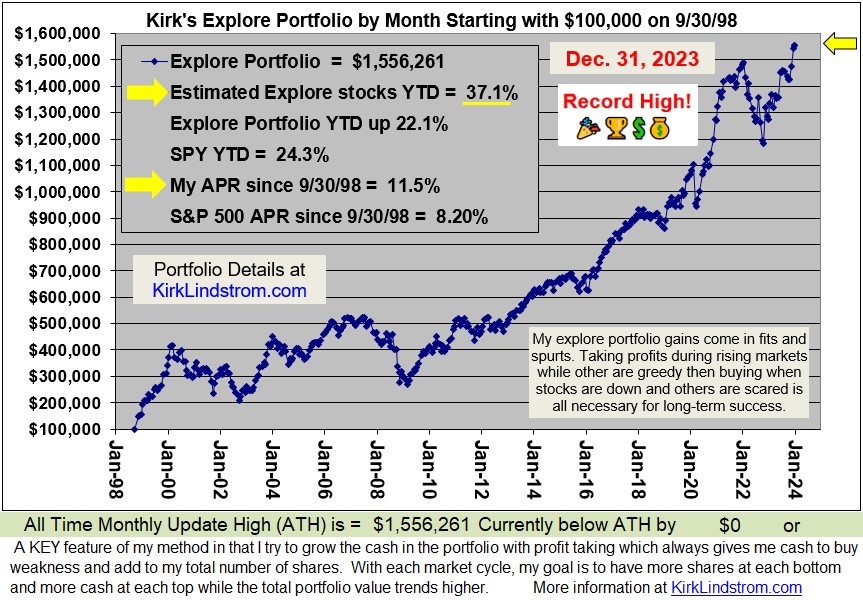
Kirk Lindstrom's Investment Letter Performance