Google
==> Very Best CD Rates with FDIC <==

Saturday, November 21, 2009

Fixed Income & Vangaurd Fund Update

Rates and Yields for Series EE Bonds, I-Bonds, VIPSX, VBMFX, VFIIX (GNMA or "Ginnie Mae") and VTSMX funds from Vanguard.

On 9/18/09 I sold the last of my explore portfolio position in Vanguard’s GNMA fund (VIIX Charts) to lock in nice gains. If ECRI is wrong and the economy falls into a depression, then we will regret selling these bond funds because they will go higher.

On 10/26/09 I bought $31,250 worth of 5-Year TIPS for the "explore portfolio" in "Kirk Lindstrom's Investment Letter" and those are up 1.9% in less than a month as expected inflation surged while ECRI's FIG remains very low.

Vanguard Comparison Table

Vanguard Fund (11/21/09)

SYMBOL

Yield

YTD

GNMA (Currently part of my explore portfolio)

VFIIX

3.09%

6.40%

Total Bond Index

VBMFX

3.30%

7.02%

Prime Money Market Fund

VMMXX

0.11%

0.52%

Inflation Protected Security Fund

VIPSX

0.89%

12.29%

Total Stock Market Index Fund

VTSMX

1.78%

24.08%

Series I Bonds & E Bonds

  • New I Bonds currently pay 3.36% for 6 months after purchase with a base rate of 0.30%.
  • Series EE bonds now pay 1.20% total rate through April 30, 2010.

These rates for new i-bonds are effective from November 1, 2009 through April 30, 2010.

On November 6, 2006 Lakshman Achuthan, managing director of ECRI, said "While the USFIG remains in a cyclical upturn, indicating a further dissipation of any deflation danger, we are not on the verge of an upsurge in U.S. inflation."

Thursday, November 05, 2009

GGR: GeoGlobal Resources Inc. - Technical Analysis: Golden Cross & Rounding Bottom Patterns

GeoGlobal Resources Inc. (GGR Charts) is about to make a "Golden Cross" chart pattern. This is where its 50-day moving average crosses above its 200-day moving average.

Click chart courtesy of stockcharts.com for full size image

I show the 50 and 200 DMA now at $1.06. With GGR trading now at $1.18, the 50 DMA should be higher tomorrow (or very soon) for an official crossing.

A Golden Crossing should show up on all sorts of trader charts so I expect money could surge into the stock. Grab your stocks and pull up your socks.....

As you can see from this longer term chart, GeoGlobal is also making a beautiful rounding bottom pattern. Also bullish is GGR appears to have successfully tested its 50 DMA which has switched from resistance to support.
Click chart courtesy of stockcharts.com for full size image

I added shares of GGR to my personal and newsletter portfolios under a buck in August (80¢ in my newsletter and ROTH portfolios) so I'm ready to go higher. I am pleased those August lows held (so far) in this recent correction.

More information
GeoGlobal Trading Success: This is a good money maker stock if you have the patience to buy when cheap and sell when very high. In my newsletter portfolio I have generated $18,276 cash, all pure profit from GGR plus I have 7,900 shares on "house money." GGR could drop to zero overnight and I'd still have profits of $18,276! I first started writing about and trading GeoGlobal about 10 years ago when it was Suite101.com/BOWG.

11/21/09 Update. GGR Closed Friday at $2.72. I took profits in my newsletter and personal portfolios at $2.75.

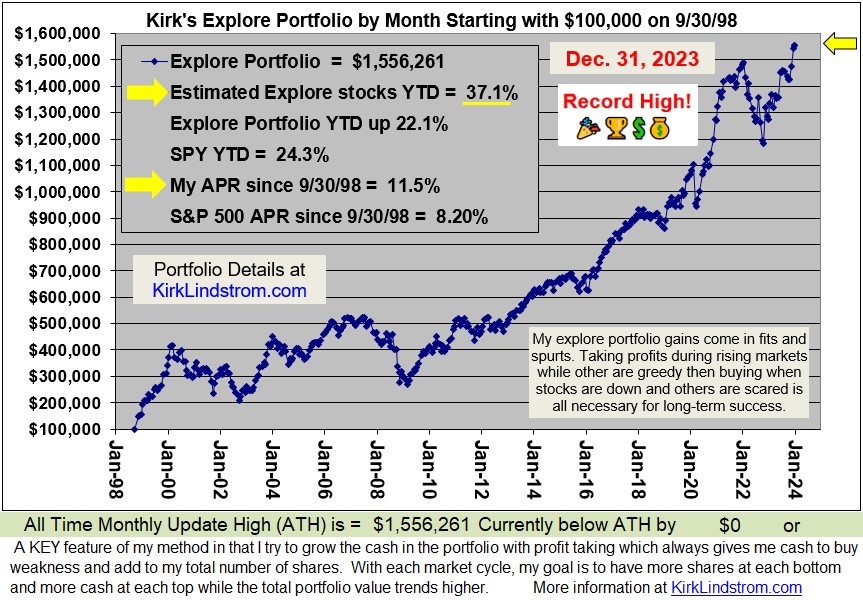
As of Nov. 11, 2009, "Kirk's Newsletter Explore Portfolio" is up 29.1% YTD vs. DJIA up 17.6% YTD

Subscribe NOW and get the November 2009 Issue for FREE! !
(Your 1 year, 12 issue subscription will start with next month's issue.)

Disclaimer: I am locked and loaded with shares added to personal and newsletter portfolios at 80¢. I have long-term shares purchased as low as 12¢ in my personal portfolio. I have plans in place to sell shares at preset, but significantly higher prices listed in my newsletter. If my outlook changes, I may sell sooner and announce it to my subscribers.

From 1/1/1999 Through 11/09/09
Kirk's 80:20 Aggressive Core Portfolio is up 50.9%
Kirk's 50:50 Conservative Core Portfolio is up 67.3%
Kirk's typically 70:30 Explore Portfolio is up 142.3%
80% Core Aggressive plus 20% Explore is up 69.1%
90% Core Conservative plus 10% Explore is up 74.8%

100% Total Stock Market (VTSMX) is up 18.2%
100% Total Bond Market (VBMFX) is up 77.7%
80% VTSMX and 20% VBMFX is up 30.1%
50% VTSMX and 50% VBMFX is up 47.9%
YTD through 11/09/09
Kirk's 80:20 Aggressive Core Portfolio is up 23.1%
Kirk's 50:50 Conservative Core Portfolio is up 16.5%
Kirk's typically 70:30 Explore Portfolio is up 24.8%

Subscribe to "Kirk Lindstrom's Investment Letter" and get the November issue for free today!

Wednesday, November 04, 2009

Best CD Rates - Survey of Largest US Banks

This table, updated today, shows the best CD rates for the five largest banks operating in the United States. These banks are Bank of America, JP Morgan Chase, Citibank, Wells Fargo Bank, and HSBC Bank North America.

CD rates (APY) at the largest US banks (Current Data) for a $10,000 deposit.

Rank
Bank
CD Rates - APY in %
as of 11/04/09 for $10,000


6- Mo
11-13 Mo
18-Mo
2-Yrs
3-Yrs
5-Yrs
1
Bank of America (BAC)
0.50
1.25
Promo
1.00
2.01
2.30
3.01
2
JP Morgan Chase (JPM)
Bought WaMu -
Washington Mutual
0.75
1.25
1.50
2.00
NA
4yrs
3.00%
3
Citibank (C)
aka
Citigroup & Citicorp
0.65
1.30
1.35
2.00
2.15
3.00
4
Wells Fargo Bank (WFC)
Bought
Wachovia - World Savings
0.35
0.90
16 Mo
1.40
21 Mo
1.90
28 Mo

NA NA
5a
HSBC Bank North America -
Branch & Telephone Rates
0.25
0.55
0.55
15-mo
0.75
0.75
1.01
5b
HSBC Online Rates
1.10
1.50
1.50
15-mo
1.30
NA NA

US Treasury Rates
0.16
0.36
NA
0.94
1.46
2.38
To see the table in full size with the current rates, click the
Notes:
  • Bank of America or BofA (BAC stock quotes and charts) was "Nations Bank" before it bought Bank of America and took the name. BofA also bought Merrill Lynch officially as of January 1, 2009.
  • JP Morgan Chase (JPM stock quote and charts) bought Washington Mutual, fondly known as "WaMu"
  • Citibank (C stock quote and charts) is also known as Citigroup & Citicorp
  • Wells Fargo Bank (WFC stock quotes and charts) bought Wachovia Bank- that bought World Savings Bank)
  • HSBC Bank North America is the American subsidiary of UK-based HSBC Holdings plc. The Hong Kong and Shanghai Banking Corporation, also a subsidiary of HSBC Holdings, acquired a 51% shareholding in Marine Midland Bank of New York in 1980 and extended to full ownership in 1987. The banks continued to operate under the Marine Midland name until 1998, when the branch offices were rebranded as HSBC Bank USA.
==> Best CD Rates with FDIC <==
A survey of large and small banks for best rates by term

One way to get four of the top five banks in a single investment is with the exchange traded fund XLF (XLF charts).

6-Month Certificate of Deposit: Secondary Market Rate

Disclaimer:
I own C (charts) and XLF (charts) in my personal account. I also cover C and XLF in my investment letter where I trade them around a core position currently in the money for both. I could sell all shares at any time to lock in my profits if my opinion sours on the sector as a whole.

Monday, November 02, 2009

I-Bond Rates: November 2, 2009 through April 30, 2010

The Bureau of the Public Debt today announced an earnings rate of 3.36% for Series I Savings Bonds issued from October 2, 2009 through April 30, 2010. Press Release

The 3.36% earnings rate for I bonds bought from November 2, 2009 through April 30, 2010 will apply for their first six months after issue. The earnings rate combines a 0.30% fixed rate of return with the 3.06% annualized rate of inflation as measured by the Consumer Price Index for all Urban Consumers (CPI-U). When the inflation rate is less than zero, a bond's earnings rate is less than its fixed rate (but the earnings rate is never less than zero).
The fixed rate applies for the 30-year life of I bonds purchased during this six-month period.
Earnings rates for I bonds are set each May 1 and November 1. Interest accrues monthly and compounds semiannually. Bonds held less than five years are subject to a three-month interest penalty. I Bonds have an interest-bearing life of 30 years.

I Bond Earnings Rate 3.36%, Fixed Rate 0.30%

Minimum purchase:
  • $50 for a $50 I Bond when purchasing paper bond certificates
  • $25 for a $25 I bond when purchased electronically via TreasuryDirect
Maximum purchase(per calendar year):
  • $5,000 in TreasuryDirect and $5,000 in paper bonds
  • $10,000 total per social security number
Denominations:
  • Paper bonds: $50, $75, $100, $200, $500, $1,000, and $5,000
  • Electronic bonds via TreasuryDirect: purchase to the penny for $25 or more
For more information, see:

For older ibonds and what they will pay, see:


Disclaimer: I own Series I Bonds in my personal account. Due to the small amount of i-bonds you can buy now, I own far more TIPS and TIPS funds in my personal and newsletter (FREE SAMPLE) portfolios.

CIT Group Bankruptcy Agreement; Common & Preferred Stock Cancelled

Yesterday CIT Group filed for bankruptcy protection with nearly 90% of their debt holders voting in favor of the agreement. The key provisions of the agreement are:
  • Emergence Sought by Year-End
  • Operating Entities Remain Unaffected and Highly Liquid
  • Continue Lending to Small and Middle Market Businesses
  • "Under the proposed prepackaged plan of reorganization, all existing common and preferred stock will be cancelled upon emergence"
Bondholders will get about $0.70 on the dollar plus new common stock while current shareholder will probably get wiped out.

Click image for full size graph courtesy of stockcharts.com

Bloomberg reported "the U.S. Treasury Department said it won’t recoup much, if any, of the $2.33 billion of taxpayer money that went into CIT, the largest firm to go bankrupt after getting a federal bailout." (Bloomberg Story)

CIT had been trading with hopes shareholders would not be wiped out. I want to make sure all my readers view the CIT Bankruptcy Press Release so you understand that the currently trading shares are worthless:
"Under the proposed prepackaged plan of reorganization, all existing common and preferred stock will be cancelled upon emergence"

Click image for full size graph courtesy of stockcharts.com

This bankruptcy is not a surprise but taxpayers will probably lose the $2.33B we invested in the company.

CIT hopes to emerge from bankruptcy in 60 days.