Don't Miss Out On Great Gains! - Best Investment Newsletter


Click for FREE sample of Kirk Lindstrom's Investment Letter

Don't miss out! Subscribe Now

google.com, pub-7001134751860982, DIRECT, f08c47fec0942fa0

Search For More

Showing posts with label Bailout. Show all posts

Monday, April 12, 2010

Taxpayer Cost of Financial Bailout

The government's bailout of the US financial system is expected to cost US taxpayers far less than originally expected. Unfortunately, the Obama administration estimate of $89 billion doesn't include the costs to taxpayers from the biggest "mistakes" that could bring the total over $450 billion!

Yesterday the Wall Street Journal cited Treasury Department officials with estimating the total cost of the bailout at $89 billion which is much lower than earlier projections of $250 billion or more.
Just a year ago, the Congressional Budget Office and Office of Management and Budget estimated that the overall bailout would cost more than $250 billion. Last month, though, Treasury Secretary Timothy Geithner said the rescues will amount to "less than 1%" of gross domestic product. The $89 billion projection is less than the cost of the savings-and-loan crisis in the 1980s and early 1990s, which totaled as much as 3.2% of GDP.
The $89B cost of the bailout includes the Troubled Asset Relief Program (TARP,) capital injections into Fannie Mae and Freddie Mac, loan guarantees by the Federal Housing Administration and Federal Reserve moves such as buying mortgage-backed securities and propping up the commercial-paper market. Taxpayers made money on many of the investments in banks such as Citigroup.
Still, of the $245 billion that Treasury invested in U.S. banks, $169 billion has been returned so far, and officials estimate an eventual profit of $8 billion.

As of February, the U.S. government has collected $13.7 billion in dividends, interest and other income, along with $4 billion in warrant proceeds.
The politicians like to blast the bankers on TV to take the heat off the biggest drain on taxpayers, the GSEs (Government Sponsored Entities) known as Fannie Mae (FNM) and Freddie Mac (FRE.) which are responsible for the majority of the taxpayer losses.

The $89B estimate does not include losses at Fannie Mae and Freddie Mac, which are projected to be $370 billion through 2020!!!
According to the CBO, losses related to the investment portfolios of Fannie Mae and Freddie Mac are projected to total $370 billion through 2020, though the figure will fluctuate depending on the health of the housing market. The Treasury's $89 billion estimate for the total bailout cost doesn't incorporate CBO's projected losses at Fannie and Freddie because, for budgeting purposes, the Obama administration technically considers them private entities. Taxpayers are potentially on the hook for losses at Fannie and Freddie.
Adding in the $370 billion projected cost of the bailout at Fannie Mae and Freddie Mac to the current CBO estimate of $89 billion for everything else gives a total cost to taxpayers of the financial bailout of $459 billion!

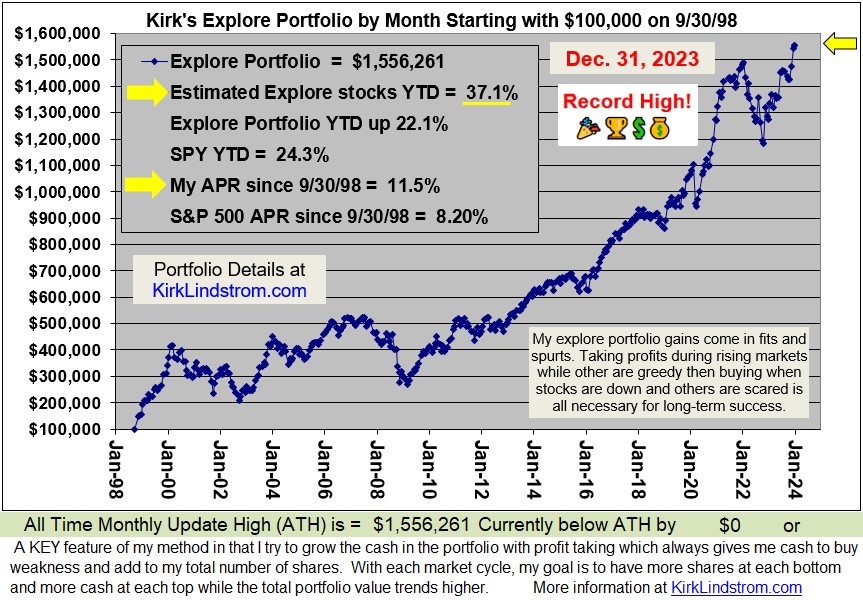
Since 12/31/98 "Kirk's Newsletter Explore Portfolio" is UP 159% (a double plus another 59%!!) vs. the S&P500 UP a tiny 8.6% vs. NASDAQ UP a tiny 3.5% (All through 12/31/09)

In 2009, "Kirk's Newsletter Explore Portfolio" gained 33.5% vs. the DJIA up 18.8%
As of 4/11/10, the explore portfolio is up 7% YTD
FREE SAMPLE

Subscribe NOW and get the April 2010 Issue for FREE! !
(Your 1 year, 12 issue subscription will start with next month's issue.)


Wednesday, September 24, 2008

Financial Meltdown; Who To Blame?

The last two days I have listened to Federal Reserve chairman Ben Bernanke and US Treasury Secretary Hank Paulson testify before congress in favor of a $700 Billion package to "bailout" the financial markets and the US economy.

There is an old cliche that applies. It says when a person with money meets a person with experience, the person with the experience leaves with the money and the person with the money ends up with an experience. Usually Wall Street has the experience while tax payers and greedy investors start out having the money.

To me, blaming Wall Street it is similar to blaming the great white sharks off our California coast for eating the occasional surfer.

Earlier today Warren Buffett said this is an "economic Pearl Harbor" we are going through. When asked what would happen if the package proposed by Paulson and Bernanke fails to get quick approval, Buffett said
It will get worse. Last week will look like Nirvana if they don't go through with a plan to get the country back on the right track. Huge institutions in the World all want to deleverage at the same time. We need someone large, like the US government, to step up and provide liquidity. If they do it right, and I think they will, then the US Government will make a lot of money.
[See Warren Buffett on Goldman Sachs and Financial Bailout Package.]
When asked about punishing those responsible, Buffet said
I think the CEOs and directors should be punished for what they did, but I would not write this into the legislation.
Am I the only one who finds it odd that nobody is blaming:
  • The people who took out loans they could not pay back?
  • The schools for not teaching people enough to understand compound interest or that what goes up in price often crashes faster than it went up?
  • The people who bought homes as "investments" that went down in price? I know many here in California who were speculating on being able to sell for a quick gain before their teaser loan rates turned into very expensive loans. They gambled and lost just like some of us lost buying troubled stocks that went out of business.
If all the "sub prime" borrowers were smart enough to know
  • that their house would not keep going up forever
  • that they could not afford to pay their mortgages when the intro rates ended
  • that their house could plummet in value if they were the last one to buy before the housing bubble collapsed
then we would not be in this problem because the sharks on Wall Street could not take advantage of them.

The fault seems to be in regulations that didn't step up and notice many were getting toxic loans they didn't understand. At the peak of the bubble, my housekeeper was thinking of buying a house in the area of San Jose that is now off 40%. I took a few minutes to explain to her how dangerous the loans were that she would "qualify" for and the only one who PROBABLY will come out ahead in a few years is the person who gets a fee to get her to sign the papers. I explained to her what was happening and told her to not sign ANY papers until she let me look them over to see if she was getting screwed and could afford the payments should the economy sour where people decided to clean their own houses or her husband lost his job building new homes.... She didn't buy and they are doing fine as renters... and her husband cleans carpets now so they can pay their bills, drive nice cars and care for their kids.

If you really want to fault people
  • Fault the schools for keeping people stupid about math and compound interest.
  • Fault a society that pushed huge homes and expensive SUVs on people who could be happy with half the lifestyle and far less debt.
  • Finally, fault the greedy people who closed their eyes to the risks just like they do when they buy lotto tickets or trips to Las Vegas. One multimillionaire friend (at least he was two and a half years ago) asked for my advice about an $800,000 condo in Vegas he paid $4000 for the right to bid on (got a refund when his bid was accepted). I told him I would look to sell immediately as that was the classic sign of a top when they find people who will pay a finders fees to buy stuff that has not been built yet. He was so mad he did not set up the planned lunch to balance my buying him his lunch nor would he return my emails! Now I bet he wishes he listened to me.
Sure the people at the top knew their were selling loans to people that could not pay them back. Just as I have no problems killing great white sharks that eat humans, I believe the CEOs and directors at these failed companies should be punished. They had a duty to shareholders to manage their companies for the future. They should be held accountable in civil court by shareholders to disgorge every penny they made but lets not forget that the reason the sharks got so rich is the waters were filled with clueless swimmers.

Sunday, September 21, 2008

Details of Financial Bailout Package

In an effort to end the worst financial disaster since The Great Depression, on Saturday the Bush Administration sent congress a $700 billion plan to purchase toxic debt from troubled financial institutions.


The Democrats, who control both the House and Senate, questioned whether there were sufficient protections for taxpayers and homeowners, but they acknowledged the need to act quickly. Some Democrats said they might use the opportunity to add some limits on what corporate executives are paid and look for ways to reduce home foreclosures.

Some details of the plan:
  • Raises the public debt limit to $11.3 trillion.

  • Earlier this year, Congress voted to increase the debt limit to $10.6 trillion as part of omnibus housing legislation that included broader federal authority over Fannie Mae and Freddie Mac. Fannie and Fannie have since fallen under government control. See The Rise and Fall of Fannie Mae and Freddie Mac

  • The proposal would give the US Treasury secretary Paulson significant leeway in buying, selling and holding residential or commercial mortgages, as well as "any securities, obligations or other instruments that are based on or related to such mortgages."

  • Total purchases can not exceed $700 billion outstanding at any one time.

  • Treasury could hire asset managers to handle the debt purchases, which could include residential or commercial mortgages and related instruments that were originated or issued on or before Sept. 17, 2008.

  • Hedge Funds would not be eligible under the plan to offload troubled assets.
House Speaker Nancy Pelosi (D., Calif.) said, "We will strengthen the proposal by ensuring that the government is accountable to the taxpayers in any future actions under this broad grant of authority, implementing strong oversight mechanisms, and establishing fast-track authority for the Congress to act on responsible regulatory reform."

Senate Majority Leader Harry Reid (D., Nev.) was more critical saying, "while the Bush proposal raises some serious issues, we need to resolve them quickly."

Financial Services Chairman Barney Frank (D., Mass.) would like to see limits put on executive compensation.

The Republicans praised the plan and called for swift action to enact the required legislation.

Treasury secretary Hank Paulson said "I am convinced that this bold approach will cost American families far less than the alternative -- a continuing series of financial-institution failures and frozen credit markets unable to fund economic expansion."

The stock markets liked the news and rallied Thursday and Friday, but they remain in bear market territory. See Market Update for September 21, 2008

I was a buyer Wednesday, Thursday and Friday. To learn what I bought for my newsletter explore portfolio, subscribe now!

Click chart courtesy of stockcharts.com for full size image

More:

Friday, September 19, 2008

Financial Bailout - A Day To Remember

The rescue or bailout by the US Treasury and the Federal Reserve is the biggest in history. The details are being hammered out with a joint session of congress, the Fed and Treasury Secretary Henry Paulson Jr. representing the executive branch. So far:
  • The US Government will insure $2 TRILLION of money market funds. The Fed came in to assist by loaning money to troubled funds to help them not "break the buck."

  • Federal Reserve will take on about half a trillion ($500 BILLION) of bad debt

  • Government made it illegal to short financial stocks on a list.

  • President Bush, Congress (Senate and House of Reps) and the Federal Reserve are united in saying a tax payer sponsored bailout is better than a financial collapse.
Keep checking back as I update this blog with new information.

From Wikipedia:
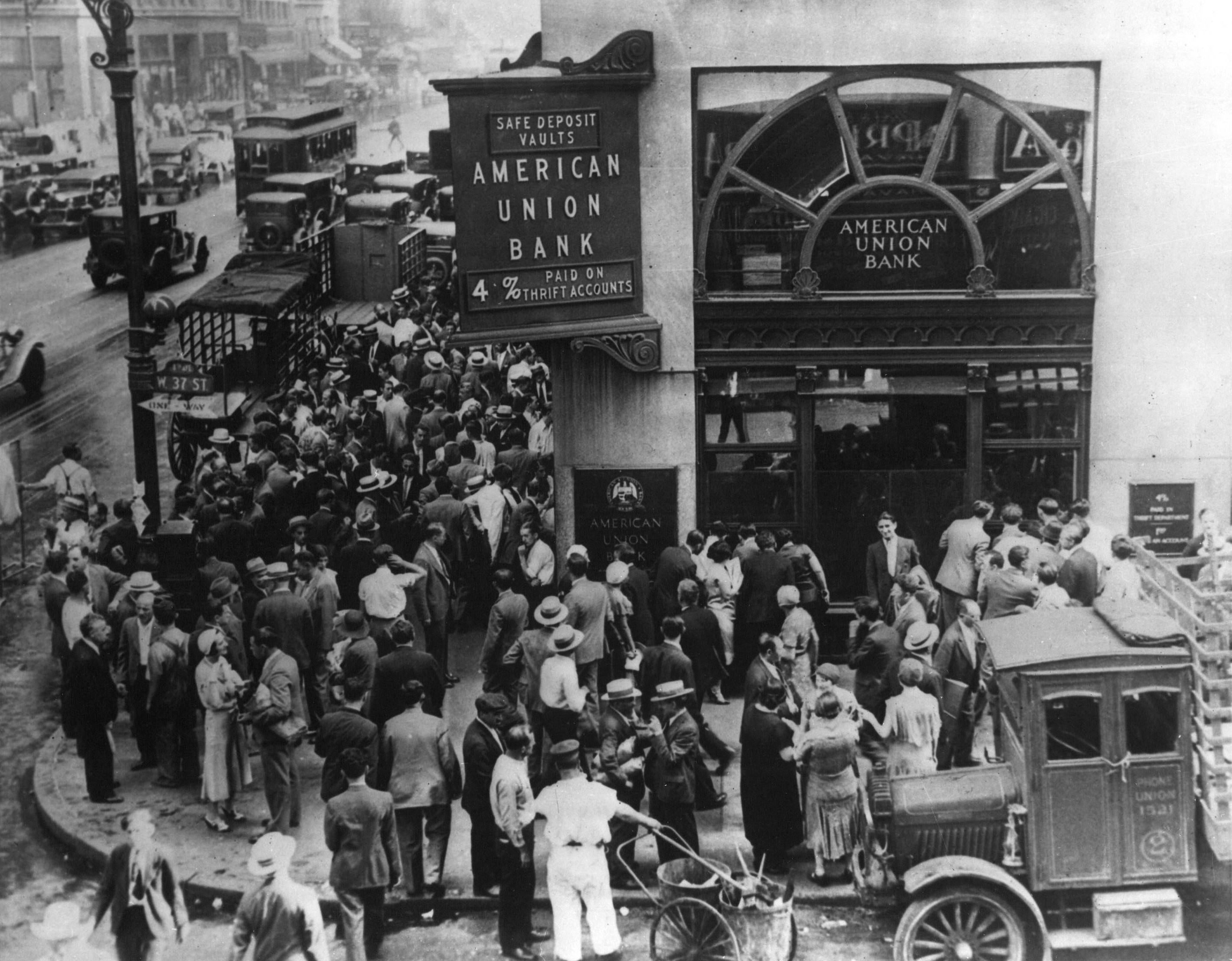
Crowd at New York's American Union Bank during a bank run early in the Great Depression. The Bank opened in 1917 and went out of business on June 30, 1931.

Followers - Click "follow" to get an email alert for new articles

Kirk Lindstrom's Investment Letter Performance