Don't Miss Out On Great Gains! - Best Investment Newsletter


Click for FREE sample of Kirk Lindstrom's Investment Letter

Don't miss out! Subscribe Now

google.com, pub-7001134751860982, DIRECT, f08c47fec0942fa0

Search For More

Showing posts with label FDIC Troubled Bank List. Show all posts

Friday, March 10, 2023

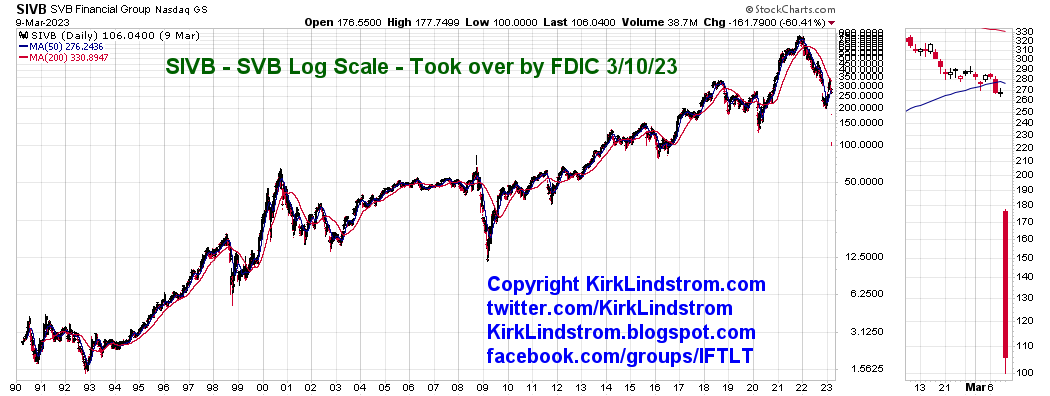
SIVB Silicon Valley Bank Fails - FDIC Steps In

SIVB Fails.  This is quite the story of a bank failure (taken over by "regulators" aka FDIC.)   In a nutshell they needed to raise funds to meet withdrawals from customers wanting some of their funds on deposit to buy higher yielding US treasuries or even money funds at brokers paying well over 4%.  To raise the funds, they had to sell some of their own US treasury portfolio at a loss because they bought those bonds when rates were low and they were paying next to nothing on deposits.   


From FDIC Press Release:  FDIC Creates a Deposit Insurance National Bank of Santa Clara to Protect Insured Depositors of Silicon Valley Bank, Santa Clara, California
WASHINGTON – Silicon Valley Bank, Santa Clara, California, was closed today by the California Department of Financial Protection and Innovation, which appointed the Federal Deposit Insurance Corporation (FDIC) as receiver. To protect insured depositors, the FDIC created the Deposit Insurance National Bank of Santa Clara (DINB). At the time of closing, the FDIC as receiver immediately transferred to the DINB all insured deposits of Silicon Valley Bank.
All insured depositors will have full access to their insured deposits no later than Monday morning, March 13, 2023. The FDIC will pay uninsured depositors an advance dividend within the next week. Uninsured depositors will receive a receivership certificate for the remaining amount of their uninsured funds. As the FDIC sells the assets of Silicon Valley Bank, future dividend payments may be made to uninsured depositors.
Silicon Valley Bank had 17 branches in California and Massachusetts. The main office and all branches of Silicon Valley Bank will reopen on Monday, March 13, 2023. The DINB will maintain Silicon Valley Bank’s normal business hours. Banking activities will resume no later than Monday, March 13, including on-line banking and other services. Silicon Valley Bank’s official checks will continue to clear. Under the Federal Deposit Insurance Act, the FDIC may create a DINB to ensure that customers have continued access to their insured funds.
As of December 31, 2022, Silicon Valley Bank had approximately $209.0 billion in total assets and about $175.4 billion in total deposits. At the time of closing, the amount of deposits in excess of the insurance limits was undetermined. The amount of uninsured deposits will be determined once the FDIC obtains additional information from the bank and customers.
Customers with accounts in excess of $250,000 should contact the FDIC toll-free at 1-866-799-0959.
The FDIC as receiver will retain all the assets from Silicon Valley Bank for later disposition. Loan customers should continue to make their payments as usual.
Silicon Valley Bank is the first FDIC-insured institution to fail this year. The last FDIC-insured institution to close was Almena State Bank, Almena, Kansas, on October 23, 2020.
The problem is after the Fed raised rates so quickly, assets held in longer term, low yield US Treasuries when "marked to market" are worth much less now.  IF held to term, US Treasury holders will get their money back plus interest but if they need the money now, such as meeting depositors removing their liquid cash to get CA tax free, higher yield US treasuries from a broker or directly from the US treasury, then they are sold at a loss.

My Facebook Discussion: Silicon Valley Bank collapses after failing to raise capital

Kirk Lindstrom's Investment Letter
To see what stocks and ETFs are in my "Explore Portfolio" and get a full list of on my price targets to both take profits or buy more:
 Subscribe NOW  and get
the
 March 2023 
Issue for FREE!!
(If you mention this ad)
Reminder, you can subscribe to this feed for free to get sent emails by Google when I post new charts and articles. Just click "Follow" below.
 

Thursday, February 26, 2009

FDIC List of Banks in Danger of Failure Soars 47%

Today the chairwoman of the FDIC, Sheila Bair, said the "Problem List" of troubled banks currently includes 252 banks with assets of $159B. This is up 47% from the third quarter of 2008 when the list stood at 171 banks.

She said this is one of the most difficult periods in the FDIC's 75 year history of operation.

In 2008 there were 292 bank mergers, 25 bank failures, 5 FDIC "assistance transactions." The 25 bank failures was the largest number since 1993.

There are now a total of 8,305 FDIC insured banks and savings and loans.

The banking industry lost $26.2 Billion in the fourth quarter of 2008. Worst since 1990.

Full year net income was down 84% to $16.1B, also the lowest since 1990.

FDIC reserve for bank failures fell by $16B and now stands at $19B.

The FDIC may ask for a special assessment on the industry banks to recharge their reserves.

The good news was Domestic Deposits Increased by 3.8 Percent
"Public confidence in the banking system and deposit insurance is demonstrated by the increase in domestic deposits during the fourth quarter," FDIC Chairman Sheila Bair said. "Clearly, people see an FDIC-insured account as a safe haven for their money in difficult times."
Problem List: The FDIC does not make its list of member institutions in danger of failing public because it does not want to contribute to a "run on the bank" by concerned depositors. One indication a bank may be on the list is they pay very high CD rates in an attempt to attract capital. Richard (Dick) Bove of Landenburg Thalmann has a methodology for estimating what banks are in trouble.
See Dick Bove's List of Banks In Danger of Failing
IndyMac Bankcorp was at the top of Bove's list before it failed based on non performing assets as a percentage of equity.


The top rates for CDs this week are at Pentagon Federal Credit Union (fondly known as PenFed CU) for 5 and 7-year certificates of deposit that currently pay 4.39% APY.

For shorter term, Corus Bank has a 1-year CD with a 2.93% annual percentage rate.

For online savings, GMAC Bank is paying 2.75% on any deposit over $500.

With rates so low, banks will try to sell you their annuity products. Make sure you read our article "Beware of Annuities."

The table below shows the best CD rates for other terms. If that table is hard to read, then try Very Best CD Rates.

"Highest CD Rate Survey + Current US Treasury Rates"
Term
Date
Highest
Rate (APY)
Where?
(Click link for Full Rate Sheets)
Daily Savings
2/24/09
1.21%
Vanguard Prime Money Market Fund
Tax Exempt
2/24/09 0.77%
Vanguard Tax Exempt Money Market Fund
Online Savings 2/24/09 2.75%
GMAC Bank & 2.25% @ HSBC Bank
3-Month Treasury
2/24/09 0.30%
US Treasury Rates at a glance
6 Months 2/24/09 2.60%
GMAC Bank
6-Month Treasury
2/24/090.50%
US Treasury Rates at a glance
9 Months 2/24/09 2.75%
GMAC Bank
1 Year
2/24/09 2.93%
Corus Bank 2.90% @ GMAC Bank
1 Year Treasury 2/24/09 0.70%
US Treasury Rates at a glance
18 Months 2/24/09 2.90%
Intervest Bank & UmbrellaBank
2 Years
2/24/09 3.00% UmbrellaBank & 2.95% @ GMAC Bank
2 Year Treasury 2/24/09 0.98%
US Treasury Rates at a glance
3 Years 2/24/09 3.40% Flagstar Bank
3-Yr Treasury
2/24/091.37%
US Treasury Rates at a glance
4 Years
2/24/09 4.15% PenFed Credit Union
5 Years
2/24/09 4.39% Pentagon Federal CU
5 Yr Treasury
2/24/091.89%
US Treasury Rates at a glance
7 Years 2/24/09 4.39% Pentagon Federal CU & 3.50% @ Discover Bank
10 Yr Treasury
2/24/09 2.80%
US Treasury Rates at a glance
10 Years 2/24/09 3.50%
Discover Bank
30 Yr Treasury 2/24/09 3.50%
US Treasury Rates at a glance

With rates so low, banks will try to sell you their annuity products. Make sure you read our article: Beware of Annuities

(FDIC Feb. 26, 2009 Press Release)

Sunday, August 31, 2008

FDIC List of Banks in Danger of Failure Soars

FDIC List of Problem Banks up 30%: On Tuesday, August 26, 2008 the Federal Deposit Insurance Corporation (FDIC www.fdic.gov) announced in its quarterly banking report that their list of "problem banks" (see "Problem List" below) for the second quarter of 2008 increased 30% from to 117 financial institutions. The 117 institutions on the problem list is the largest number since the middle of 2003. Total assets of institutions on the problem list increased 200% from $26 billion to $78 billion. $32 billion of this $56 gain came from IndyMac Bank, F.S.B., Pasadena, CA, which failed in July.
NEW==> Thursday, February 26, 2009:
FDIC List of Banks in Danger of Failure Soars 47%
Reported net income of member institutions fell 86.5% or $31.8 billion to only $5.0 billion, the lowest earnings for the industry except for the fourth quarter last year (2007) and the fourth quarter of 1991.
"By any yardstick, it was another rough quarter for bank earnings, but the results were not unexpected as the industry coped with financial market disruptions, the housing slump, worsening economic conditions and the overall downturn in the credit cycle." said FDIC Chairman Sheila C. Bair.
This decline in the banking industry is reflected in the Economic Cycle Research Institute's (ECRI) Weekly leading index which has fallen to a 28-year low, the lowest reading since June 13, 1980.
For more information, see:
Other major findings in the FDIC's latest Quarterly Banking Profile include:

Provisions for loan losses continue to be the main cause of falling earnings.
"Rising levels of troubled loans, particularly in real estate portfolios, led many institutions to increase their provisions for loan losses in the quarter. Loss provisions totaled $50.2 billion, more than four times the $11.4 billion the industry set aside in the second quarter of 2007. Almost a third of the industry's net operating revenue (net interest income plus total noninterest income) went to building up loan-loss reserves."
Noncurrent loans are up 20% to 2.04% of all loans. The number continues to rise quickly to the highest level since 1993.
"The amount of noncurrent loans and leases (90 days or more past due or in nonaccrual status) increased by $26.7 billion during the second quarter, following a $26.2 billion increase in the first quarter and a $27.0 billion increase in the fourth quarter of 2007. Almost 90 percent of the increase in noncurrent loans and leases in the last three quarters consisted of real estate loans, but noncurrent levels have been rising in all major loan categories. "

Assets of insured member institutions declined.
"Total assets of FDIC-insured institutions declined during the quarter for the first time since 2002. The $68.6 billion (0.5 percent) decline was caused by a reduction in trading assets at a few large banks. Assets in trading accounts, which increased by $135.2 billion in the first quarter, declined by $118.9 billion (11.8 percent) in the second quarter. In addition, the industry's holdings of one- to four-family residential mortgage loans fell by $61.4 billion (2.8 percent). Real estate construction and development loans declined for the first time since 1997, falling by $5.4 billion (0.9 percent)."

The FDIC's Deposit Insurance Fund reserve ratio fell.
"Due to a significant increase in loss reserves, including reserves for failures that have occurred since June 30th, the DIF balance fell to $45.2 billion at the end of the second quarter, down from $52.8 billion at the end of the first quarter. While insured deposits rose only 0.5 percent during the quarter, the decline in the fund balance caused the reserve ratio to fall to 1.01 percent as of June 30th from 1.19 percent one quarter earlier. Because the reserve ratio is now below 1.15 percent, the Federal Deposit Insurance Reform Act of 2005 requires the FDIC to develop a restoration plan that will raise the reserve ratio to no less than 1.15 percent within five years."
Problem List: The FDIC does not make its list of member institutions in danger of failing public because it does not want to contribute to a "run on the bank" by concerned depositors. One indication a bank may be on the list is they pay very high CD rates in an attempt to attract capital. Richard (Dick) Bove of Landenburg Thalmann has a methodology for estimating what banks are in trouble.
See Dick Bove's List of Banks In Danger of Failing
IndyMac Bankcorp was at the top of Bove's list before it failed based on non performing assets as a percentage of equity.

Graph: ECRI's WLI growth vs the DJIA

Make sure you read the attached "August 2008 Fixed Income Report" to see my graph of ECRI's WLI growth rate vs. the DJIA. You can see WLI growth started its plunge well before the stock market peaked last summer.

Followers - Click "follow" to get an email alert for new articles

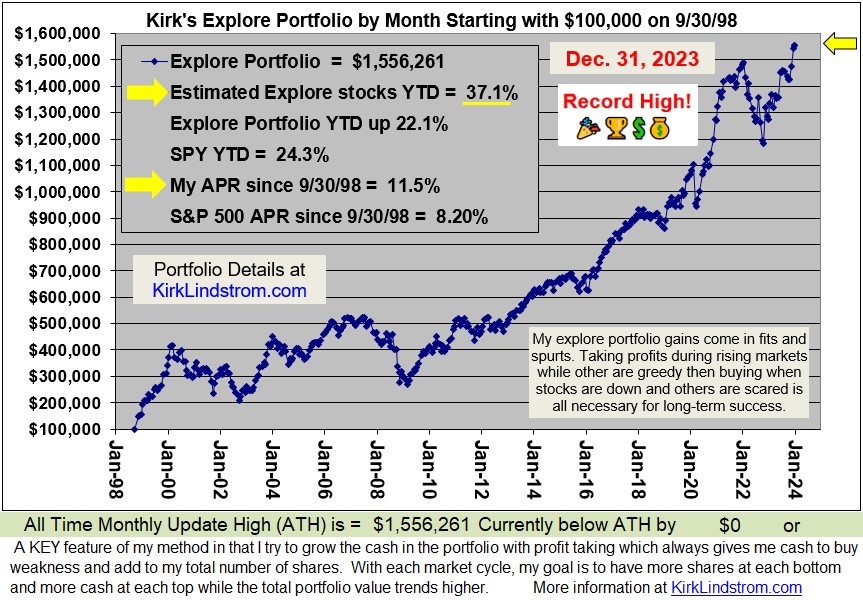
Kirk Lindstrom's Investment Letter Performance