Don't Miss Out On Great Gains! - Best Investment Newsletter


Click for FREE sample of Kirk Lindstrom's Investment Letter

Don't miss out! Subscribe Now

google.com, pub-7001134751860982, DIRECT, f08c47fec0942fa0

Search For More

Showing posts with label George Soros. Show all posts

Thursday, January 26, 2012

George Soros 2012 Market Outlook

George Soros Market Outlook for 2012.  Soros says there is the POTENTIAL for a total meltdown greater than the 2008 financial crisis.
"I am not here to cheer you up. The situation is about as serious and difficult as I've experienced in my career... The best-case scenario is a deflationary environment. The worst-case scenario is a collapse of the financial system... At times like these, survival is the most important thing."
-George Soros January 25, 2012 on CNBC
From Davos Switzerland to Maria Bartiromo.

More quotes:

About the possible Greek default:
"It did not solve the problem of the heavily indebted countries that now are in a position of a Third World country that it is too heavily indebted in a foreign currency"
Without intervention, Soros continued
"It actually could eventually prepare the ground for a breakdown of the euro, if the financial system of each country becomes much more self-contained. But that's not really where they want to go...  Gradually it's bringing down the interest rates. However, I don't think it's a strong enough 'ring fence' if and when Greece defaulted. And there is a real danger of that happening, a possibility... You'll either have disintegration and the euro falling apart, which would have catastrophic consequences, and really a potential meltdown, worse than you had in 2008, a real disintegration. Or, you have more integration"
About the US, Soros said it is on the mend
"The economy actually is showing considerable strength... the glut of cheap natural gas, for shale gas, is making a big difference in making American manufacturing more competitive. You see strength in manufacturing, which is really a reversal of the trend of last 20 years."
Long Term Results that Speak for Themselves
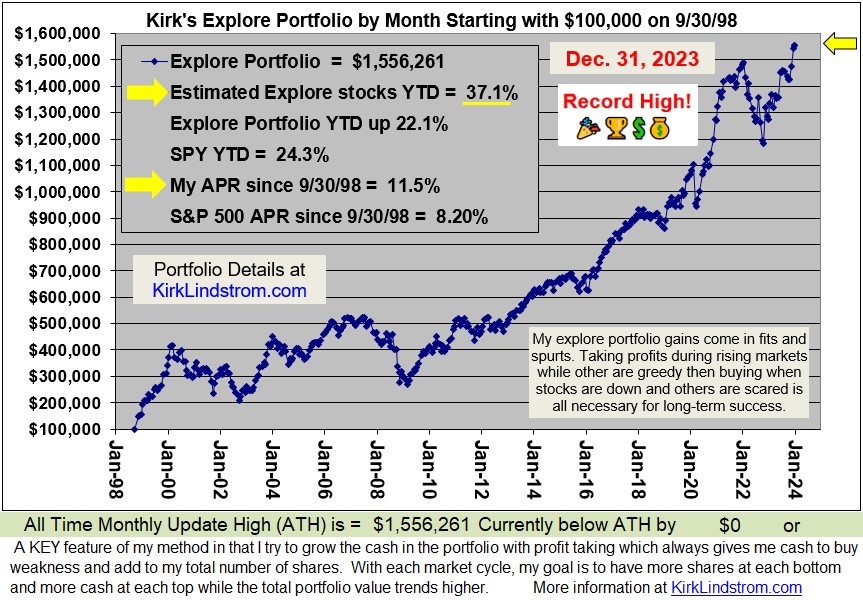
Since 9/30/98 inception, "Kirk's Newsletter Explore Portfolio" is UP 390%
vs. the S&P500 UP only 51% vs. NASDAQ UP only 57% (All through 12/31/11
(More Info, Testimonials & Portfolio Returns)
Latest 2012 Update:  Up 8.0% YTD  as of 1/26/12

 Subscribe NOW and get the January 2012 Issue for FREE!  
(Your 1 year, 12 issue subscription will start with next month's issue.)

Monday, October 11, 2010

George Soros Market Outlook - Says End Bush Tax Cuts

George Soros Expects Global Slowdown
Today Maria Bartiromo interviewed George Soros on CNBC's "Closing Bell."  Soros said he expects the global economic slowdown to continue into 2011 and we need more fiscal stimulus to avoid a second recession.  He also thinks extending the Bush tax cuts to the wealthy is a mistake.  Summary of his Key comments.
  • The recession has been shorter and shallower than it would have been had the countries not worked together to provide economic stimulus.
  • We are in danger of a second slowdown unless we get more fiscal stimulus which political debate is making near impossible.
  • Extending the Bush tax cuts for the top two percent is a bad idea because in the long term "we need a prosperous economy." Short term, it would help him but he believes in the long term it is the wrong thing to do since we need to pay for fiscal stimulus.
  • Extending Bush tax cuts to the middle class, those making under $250,000, is the "right thing to do."
  • Governments need to prevent a "currency war."
  • China has to move on its current currency position. Says China's capital controls allows it to control their currency and others. So China is now the dominant factor in how other currencies move so they can put pressure on Japan but Japan can not buy currency of China which makes it unfair.
  • The developed markets and China are slowing down.
  • Soros says it is "tragic" that the Republicans want to satisfy their contributors who want a tax cut rather than the general good of the public. He seems amazed "they managed to get the whole public to buy into it."
  • "I follow Greece very closely." He says Greece is succeeding with very harsh steps.
  • "The Euro is here to stay." Says a rescue mechanism, that they now have, was the missing ingredient.
Since 12/31/98 "Kirk's Newsletter Explore Portfolio" is UP 174% (a double plus another 74%!!) vs. the S&P500 UP a tiny 15.2% vs. NASDAQ  UP a tiny 9.6%   (All through 10/11/10) 
 

Subscribe NOW and get the October 2010 Issue of "Kirk Lindstrom's Investment Letter" for FREE!
(Your 1 year, 12 issue subscription will start with next month's issue.)
In 2009, "Kirk's Newsletter Explore Portfolio" gained 33.5% vs. the DJIA up 18.8%
2010 YTD the "Explore Portfolio" is up 6% YTD


Tuesday, March 02, 2010

George Soros Says Gold is in Early Stage of Asset Bubble

George Soros believes gold is in the early phase of an asset bubble. Just as NASDAQ staock were a good buy in 1998, Mr.Soros thinks gold is a good buy now.

Make sure to read

From Soros signals gold bubble as Goldman predicts record at the Financial Post:
"When interest rates are low we have conditions for asset bubbles to develop, and they are developing at the moment," Mr. Soros said at the World Economic Forum's annual meeting in Davos, Switzerland, in January. "The ultimate asset bubble is gold," he said.

In a Jan. 28 Bloomberg Television interview, the 79-year-old billionaire recalled that former Federal Reserve Chairman Alan Greenspan warned of "irrational exuberance" in financial markets three years before the technology bubble burst in 2000. The Standard & Poor's 500 Index rose 89% in the period.

Buying at the start of a bubble is "rational," Mr. Soros said.
According to a Feb. 16 Securities and Exchange Commission filing, the $25 billion "Soros Fund Management LLC" increased its investment in the SPDR Gold Trust GLD (Quote and charts) by 152% in the fourth quarter. GLD is the world's largest exchange-traded fund for gold.

Click for full size image courtesy of stockcharts.com

See recent articles:
Chart of Gold vs GLD

Quotes and Charts for
Gold and GLD


Thursday, January 29, 2009

George Soros Reflections on 2008

Markets are usually efficient for large amounts of money over very long periods of time except for when they break. "The game changer," George Soros explains how the markets broke in 2008. I recommend reading the full article while I comment on some key points Soros makes below.

With my personal investing and with "Kirk's Lindstrom's Investment Letter Explore Portfolio" I try to take advantage of market inefficiencies. My critics say the market is efficient and small investors can not beat the efficient market. I usually cite Warren Buffett to show they are wrong:
“If I was running $1 million today, or $10 million for that matter, I'd be fully invested. Anyone who says that size does not hurt investment performance is selling. The highest rates of return I've ever achieved were in the 1950s. I killed the Dow. You ought to see the numbers. But I was investing peanuts then. It's a huge structural advantage not to have a lot of money. I think I could make you 50% a year on $1 million. No, I know I could. I guarantee that.
Warren Buffett in June 23, 1999 to Business Week
Now I have the Soros article to add to my response list. Soros explains what I call the "Long-Short Asymmetry" and how this broke in 2008:
First, there is an asymmetry in the risk/reward ratio between being long or short in the stock market. (Being long means owning a stock, being short means selling a stock one does not own.) Being long has unlimited potential on the upside but limited exposure on the downside. Being short is the reverse. The asymmetry manifests itself in the following way: losing on a long position reduces one’s risk exposure while losing on a short position increases it. As a result, one can be more patient being long and wrong than being short and wrong. The asymmetry serves to discourage the short-selling of stocks.

The second step is to understand credit default swaps and to recognise that the CDS market offers a convenient way of shorting bonds. In that market the asymmetry in risk/reward works in the opposite way to stocks. Going short on bonds by buying a CDS contract carries limited risk but unlimited profit potential; by contrast, selling credit default swaps offers limited profits but practically unlimited risks.

The asymmetry encourages speculating on the short side, which in turn exerts a downward pressure on the underlying bonds. When an adverse development is expected, the negative effect can become overwhelming because CDS tend to be priced as warrants, not as options: people buy them not because they expect an eventual default but because they expect the CDS to appreciate during the lifetime of the contract.

No arbitrage can correct the mispricing. That can be clearly seen in US and UK government bonds, whose actual price is much higher than that implied by CDS. These asymmetries are difficult to reconcile with the efficient market hypothesis, the notion that securities prices accurately reflect all known information.

The third step is to recognise reflexivity – that is to say, the mispricing of financial instruments can affect the fundamentals that market prices are supposed to reflect. Nowhere is this phenomenon more pronounced than in the case of financial institutions, whose ability to do business is dependent on confidence and trust. That means that “bear raids” to drive down the share prices of these institutions can be self-validating. That is in direct contradiction to the efficient market hypothesis.

Putting these three considerations together leads to the conclusion that Lehman, AIG and other financial institutions were destroyed by bear raids in which the shorting of stocks and buying of CDS amplified and reinforced each other. Unlimited shorting was made possible by the 2007 abolition of the uptick rule (which hindered bear raids by allowing short-selling only when prices were rising). The unlimited selling of bonds was facilitated by the CDS market. Together, the two made a lethal combination.

On short selling in general, Soros says:
What is the proper role of short-selling? Undoubtedly it gives markets greater depth and continuity, making them more resilient, but it is not without dangers. As bear raids can be self-validating, they ought to be kept under control. If the efficient market hypothesis were valid, there would be an a priori reason for imposing no constraints. As it is, both the uptick rule and allowing short-selling only when it is covered by borrowed stock are useful pragmatic measures that seem to work well without any clear-cut theoretical justification.
On credit default swaps, CDS:
I believe they are toxic and should be used only by prescription. They could be used to insure actual bonds but – in light of their asymmetric character – not to speculate against countries or companies.
Warren Buffett has called synthetic financial instruments "weapons of financial destruction." Soros says this:
CDS are not, however, the only synthetic financial instruments that have proved toxic. The same applies to the slicing and dicing of collateralised debt obligations and to the portfolio insurance contracts that caused the stock market crash of 1987, to mention only two that have done a lot of damage. The issuance of stock is closely regulated by authorities such as the Securities and Exchange Commission; why not the issuance of derivatives and other synthetic instruments? The role of reflexivity and the asymmetries identified earlier ought to prompt a rejection of the efficient market hypothesis and a thorough reconsideration of the regulatory regime.
xxx: More comments coming later.

The "The Retirement Advisor Conservative Capital Preservation Portfolio 3" gained 3.73% in 2008

FREE=> 2009 SAMPLE Issue <== FREE

Post or Read Comments on This Article


Followers - Click "follow" to get an email alert for new articles

Kirk Lindstrom's Investment Letter Performance