Don't Miss Out On Great Gains! - Best Investment Newsletter


Click for FREE sample of Kirk Lindstrom's Investment Letter

Don't miss out! Subscribe Now

google.com, pub-7001134751860982, DIRECT, f08c47fec0942fa0

Search For More

Showing posts with label Nouriel Roubini. Show all posts

Wednesday, March 10, 2010

Ed Hyman & Nouriel Roubini Differ Over Shape of Economic Recovery

Ed Hyman and Nouriel Roubini, often called Dr. Doom, differ on the shape of the economic recovery. Hyman says we will have a "V shaped" recovery while Roubini clings to his belief that the recovery will have a "U" shape and could have a "W" shape.

Q

Q2-08

Q3-08

Q4-08

Q1-09

Q2-09

Q3-09

Q4-09

Q1-10

GDP Growth

3.3%

(0.5%)

(5.4%)

(6.4%)

(0.7%)

2.2%

5.9%


Ed Hyman has an excellent record at predicting the economy.

You have to take what "Dr Doom" says will happen with a grain of salt. It was just a year ago that Roubini said DOW 5,000 was possible and the best the S&P500 could hope for as a rally to 720. See my March 09, 2009 article:
  • Nouriel Roubini, Dr Doom, Thinks DOW 5,000 is Possible
    In the best case, Roubini sees the S&P500 (closed today at 676.53 - Charts) at 720, a gain of 6.4%. In the worst case, Roubini thinks there could be another 20% left in the decline with the S&P500 falling as low as 500 to 600 with the DOW down to 5,000 or 6,000.

Dr. Doom was wrong but fear sells so he continues his pitch.

The following excerpts I got via email today from Nouriel Roubini as he tries to sell his services.
While maintaining his core projection of protracted U-shaped growth in the United States, Roubini argued that the risks of a double-dip recession in the United States are rising. The following content is excerpted from that analysis, the full version of which is still available just for clients on Roubini.com.

V, U and W

A slew of poor economic data over the past two weeks suggests that the U.S. economy is headed for a U-shaped recovery—at best—in 2010.
Kirk: With 5.9% growth in Q4-09, hasn't a U shaped recovery already been eliminated so all that is left are V and W shaped recoveries?
The macro news, including data on consumer confidence, home sales, construction and employment, actually suggests a significant downside risk even to the anemic levels of growth which RGE forecast for H1. The U.S. faces continued challenges in H2—particularly as historic levels of fiscal stimulus fade—and appears far too close to the tipping point of a double-dip recession.
Kirk: More stimulus is on the way including money to buy appliances and "Cash for Caulkers."
This is not the conventional wisdom. Heated debate continues to rage in the United States on whether the economic recovery will be V-shaped (with a rapid return to robust growth above potential), U-shaped (slow anemic, sub-par, below trend growth for at least the next two years) or W-shaped (a double-dip recession). The V camp includes distinguished research groups and individuals such as Ed Hyman’s ISI, Larry Meyer’s Macroeconomic Advisors, the research group of JP Morgan, Michael Mussa and others. The U camp includes—among others—Roubini Global Economics, Goldman Sachs’ U.S. economic research group, PIMCO and Ken Rogoff. As early as August 2009, I worried in a Financial Times op-ed about the risk of a double-dip recession even if our RGE benchmark scenario characterizes the risk of a W as still a low probability event (20% probability) as opposed to a 60% probability for a U-shaped recovery. Others concerned about the double-dip risk include also David Rosenberg, Gary Shilling and John Makin.

Ed Hyman and I debated whether the recovery would be U or V-shaped on a February 22 conference call attended by over 2,200 listeners. Since that call, a slew of new U.S. macro data have come out. They have been almost uniformly poor, if not outright awful.
Remember it was just a year ago that Roubini said DOW 5,000 was possible and the best the S&P500 could hope for as a rally to 720 while we posted ECRI's article saying that an economic recovery was ahead.


DOW JONES INDU ^DJI - More charts
S&P 500 - More charts

See
The good news is ECRI and Ed Hyman do not predict a double dip recession in 2010.

Thursday, December 10, 2009

Nouriel Roubini Gold & Stock Market Outlook

Not only is Nouriel Roubini, called "Dr. Doom" by many, a stock market bear, he is bearish on gold. Gold (Gold quote & Charts) is currently trading at $1123 per ounce.

"I don't believe in gold," Roubini told CNBC. "Gold can go up for only two reasons."

"[the first is] inflation, and we are in a world where there are massive amounts of deflation because of a glut of capacity, and demand is weak, and there's slack in the labor markets with unemployment above 10 percent in all the advanced economies. So there's no inflation, and there's not going to be for the time being.”

Kirk's Comment: The price of Gold is probably predicting the future out to 10 years or more much as the very low PE ratios for banking and home builders in 2006 and early 2007 predicted the financial meltdown years before it happened. Even today, stocks like Verizon and AT&T have very high dividends with low PE ratios which tells me the market expects communication bandwidth to eventually become a commodity. Low PE ratios and high dividends often say more about the long-term future than the present just as the current high price for gold may be telegraphing the future unless we get our spending under control in the US.

In simpler terms, the price of gold is predicting we will need wheelbarrows to pay interest on our national debt if congress and the white house don't change their spending ways quickly.

The second way gold can go higher in this deflationary economy, according to Roubini, is a financial Armageddon. Roubini says we've avoided that risk.

Kirk's Comment: Have we? If US Treasury interest rates eventually soar to attract money to finance our huge debt, we'll have to borrow even more money to repay the debt. With the democrats and Republicans both spending more than we take in as fast as they can, the price of gold may be predicting a different, but very real financial Armageddon.

Roubini said gold can't move up 20% to 30% unless we end up in a world of inflation or another depression.
So all the gold bugs who say gold is going to go to $1,500, $2,000, they're just speaking nonsense."

click for full size image from stockcharts.com

Nouriel Roubini is a professor at the Stern Business School at New York University, chairman of Roubini Global Economics and a weekly columnist for Forbes magazine.

Current Quotes (click for current quote and chart):
My prior updates on Dr. Doom:
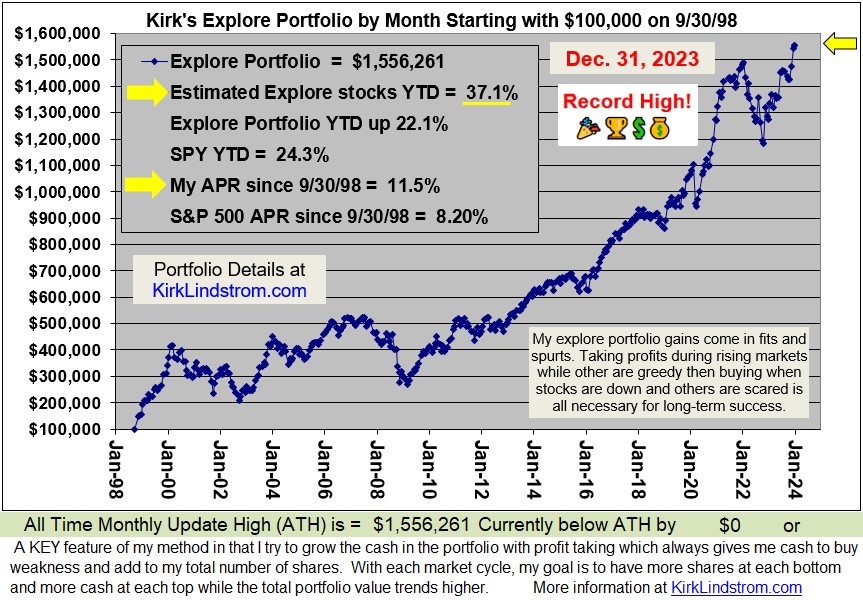
Since 12/31/98 "Kirk's Newsletter Explore Portfolio" is UP 157% (a double plus another 57%!!) vs. the S&P500 UP at tiny 7.3% vs. NASDAQ UP at tiny 0.3% (All through 12/10/09)

As of December 10, 2009, "Kirk's Newsletter Explore Portfolio" is up 32.4% YTD vs. DJIA up 18.7% YTD
(More info - Free Sample Issue)

Subscribe NOW and get the December 2009 Issue for FREE! !
(Your 1 year, 12 issue subscription will start with next month's issue.)

Disclaimer: I have no position in Gold but I do have significant personal positions in TIPS, TIPS mutual funds and iBonds plus I hold them in my newsletter portfolios.

Thursday, July 16, 2009

Nouriel Roubini, Dr. Doom, Still Gloomy

The market turned sharply up today. Some TV commentators attributed the timing of this turn to Dr. Doom, aka Dr. Nouriel Roubini, improving his outlook for the US economy.

As of July 16, 2009, "Kirk's Newsletter Explore Portfolio" is up 10.2% YTD vs. DJIA down 0.7% vs S&P500 up 5.7% YTD

Dr. Roubini appeared on CNBC after the market closed to correct this false impression. Next he sent this press release to those of us on his mailing list.
FOR IMMEDIATE RELEASE
July 16, 2009
STATEMENT ON U.S. ECONOMIC OUTLOOK BY DR. NOURIEL ROUBINI

The following is a statement from Dr. Nouriel Roubini, Chairman of RGE Monitor and Professor, New York University, Stern School of Business:

It has been widely reported today that I have stated that the recession will be over “this year” and that I have “improved” my economic outlook. Despite those reports - however – my views expressed today are no different than the views I have expressed previously. If anything my views were taken out of context.

I have said on numerous occasions that the recession would last roughly 24 months. Therefore, we are 19 months into that recession. If as I predicted the recession is over by year end, it will have lasted 24 months with a recovery only beginning in 2010. Simply put I am not forecasting economic growth before year’s end.

Indeed, last year I argued that this will be a long and deep and protracted U-shaped recession that would last 24 months. Meanwhile, the consensus argued that this would be a short and shallow V-shaped 8 months long recession (like those in 1990-91 and 2001). That debate is over today as we are in the 19th month of a severe recession; so the V is out of the window and we are in a deep U-shaped recession. If that recession were to be over by year end – as I have consistently predicted – it would have lasted 24 months and thus been three times longer than the previous two and five times deeper – in terms of cumulative GDP contraction – than the previous two. So, there is nothing new in my remarks today about the recession being over at the end of this year.

I have also consistently argued – including in my remarks today - that while the consensus predicts that the US economy will go back close to potential growth by next year, I see instead a shallow, below-par and below-trend recovery where growth will average about 1% in the next couple of years when potential is probably closer to 2.75%.

I have also consistently argued that there is a risk of a double-dip W-shaped recession toward the end of 2010, as a tough policy dilemma will emerge next year: on one side, early exit from monetary and fiscal easing would tip the economy into a new recession as the recovery is anemic and deflationary pressures are dominant. On the other side, maintaining large budget deficits and continued monetization of such deficits would eventually increase long term interest rates (because of concerns about medium term fiscal sustainability and because of an increase in expected inflation) and thus would lead to a crowding out of private demand.

While the recession will be over by the end of the year the recovery will be weak given the debt overhang in the household sector, the financial system and the corporate sector; and now there is also a massive re-leveraging of the public sector with unsustainable fiscal deficits and public debt accumulation.

Also, as I fleshed out in detail in recent remarks the labor market is still very weak: I predict a peak unemployment rate of close to 11% in 2010. Such large unemployment rate will have negative effects on labor income and consumption growth; will postpone the bottoming out of the housing sector; will lead to larger defaults and losses on bank loans (residential and commercial mortgages, credit cards, auto loans, leveraged loans); will increase the size of the budget deficit (even before any additional stimulus is implemented); and will increase protectionist pressures.

So, yes there is light at the end of the tunnel for the US and the global economy; but as I have consistently argued the recession will continue through the end of the year, and the recovery will be weak and at risk of a double dip, as the challenge of getting right the timing and size of the exit strategy for monetary and fiscal policy easing will be daunting.

RGE Monitor will soon release our updated U.S. and Global Economic Outlook. A preview of the U.S. Outlook is available on our website: www.rgemonitor.com”
Note ECRI predicts the recession will end sooner. See:

Doubled Money in a Down Market!

Since 12/31/98 "Kirk's Newsletter Explore Portfolio" is UP 114% (over a double!) vs. the S&P500 DOWN 9.2% vs. NASDAQ down 14.0% vs. Warren Buffett's Berkshire Hathaway (BRKA) up 28.1% (All through 7/16/09)

As of July 16, 2009, "Kirk's Newsletter Explore Portfolio" is up 10.2% YTD vs. DJIA down 0.7% vs S&P500 up 5.7% YTD

HURRY! Subscribe NOW and get the July 2009 Issue for FREE! !
(Your 1 year, 12 issue subscription will start with next month's issue.)

Monday, March 09, 2009

Nouriel Roubini, Dr Doom, Thinks DOW 5,000 is Possible

How low can the stock markets go? Nouriel Roubini, called "Dr. Doom" by many who didn't like his message last year before the markets crashed over 50%, says they can go much lower.

In the best case, Roubini sees the S&P500 (closed today at 676.53 - Charts) at 720, a gain of 6.4%. In the worst case, Roubini thinks there could be another 20% left in the decline with the S&P500 falling as low as 500 to 600 with the DOW down to 5,000 or 6,000.

The good news is he thinks liquidity measures instituted around the world have lessened the chances for a meltdown into a full depression, but there is a rising risk of an L-shaped "near depression" recovery. This means he thinks it will be many years for the economy to recover, not the one year for a recovery as many like Abby Cohen and Bob Brinker believe.

Roubini has argued that, in spite of the sharp fall in US and global equities significant downside risks to stock markets remain. He keeps saying that "repeated bear market rallies would fizzle out under the onslaught of worse than expected macro news, earnings news and financial markets/firms shocks." Today he wrote
"If you take a macro approach earnings per share (EPS) of S&P 500 firms will be – quite realistically in 2009 - in the $ 50 to 60 range (I say realistically as some may even argue that in a severe recession they could fall to $40). Then, the question is what the multiple, i.e. the price earnings (P/E) ratio will be on such earnings. It is realistic to expect that the multiple may fall in the 10 to 12 range in a U-shaped recession. Then, even in the best scenario (earnings at 60 and P/E at 12) the S&P index would be at 720. If either earnings are closer to 50 or the P/E ratio is lower at 10 then the S&P could fall to 600 (12 x 50 or 10 x 60) or even to 500 (10 x 50). Equivalently the Dow (DJIA) would be at least as low as 7000 and possibly as low as 6000 or 5000. And using a similar logic we argued that global equities – following the US - had another 20% plus downside risk."
He thinks any rally in 2009 would be a "bear market sucker's rally" driven by temporary improvements in the rate of change (second derivative) in economic growth from stimulis in China and the United States:
Of course you cannot rule out another bear market sucker’s rally in 2009, most likely in Q2 or Q3: the drivers of this rally will be the improvement in second derivatives of economic growth and activity in US and China that the policy stimulus will provide on a temporary basis: but after the effects of tax cut will fizzle out in late summer and after the shovel-ready infrastructure projects are done the policy stimulus will slack by Q4 as most infrastructure projects take year to be started let alone finished; similarly in China the fiscal stimulus will provide a fake boost to non-tradeable productive activities while the traded sector and manufacturing continues to contract. But given the severity of macro, household, financial firms and corporate imbalances in the US and around the world this Q2 or Q3 sucker’s market rally will fizzle out later in the year like the previous 5 ones in the last 12 months.
Roubini thinks US and Global equities could fall anouther 40 to 50%:
On the downside we have argued here that there is at least a third probability of a L-shaped global near depression rather than the mere current severe U-shaped recession. If a near depression were to take hold globally a 40% to 50% further fall in US and global equities from current levels could not be ruled out. But in this L-shaped near depression the last thing one would have to worry about would be stock markets as more severe issues would have to be addressed (unemployment rates in the mid-double digits – 15% or above - and multi-year stagnation and deflation).
Roubini thinks Abby Joseph Cohen is too bullish in her belief that investors will give the market a PE as high as 17 or more as they discount earnings getting better:

Earlier this year – at the peak of the latest bear market rally - I met Abby Cohen – the ever bullish equity markets expert at Goldman Sachs who predicted a 25% equity rally for 2008 and is making again a similarly bullish call for 2009. I asked her if we disagreed on earnings or on the multiple (P/E). It turns out that our forecast for earning per share for S&P 500 firms are similar: 50-60 range for me, 55-60 range for her. But she argued that a P/E in the 10 (to) 12 range was too low as investors would ignore the bad earnings numbers for 2009: if a rapid recovery of earnings were to occur in 2010 and beyond investors would discount the 2009 bad number and assign to them a much higher multiple of 17 or even more.

Roubini thinks Cohen is wrong. He does not believe we will have a significant economic recovery in 2010.

The trouble with that argument is that, with the US and global economy in a massive slump and with deflationary forces at work it is hard to believe that a massive economic recovery will occur in 2010 thus lifting sharply earnings: even in a U-shaped scenario US growth in 2010 would be 1% or lower and Eurozone and Japanese growth would be close to 0%. Thus, with weak growth deflationary pressure would be still lingering thus putting pressure on profits, pricing power of firms and thus profit margins. Thus, even in a U-shaped scenario a rapid rally of equities is highly unlikely.

Bob Brinker (Brinker Fan Club), like Abby Cohen, has said the same thing about PE ratios and he too was bullish in 2008 for an up year that did not happen. Roubini remains bearish and thinks the markets will bottom in the next 12 to 18 months. He cites how the last recession ended in 2001 and the markets did not bottom until 2002:

Also the “6-9 months ahead forward looking stock market view” is not always borne in the data. During the last recession the economic bottomed out in November 2001 and GDP growth was robust in 2002 but the US stock markets kept on falling all the way through the first quarter of 2003. So not only the stock market were not “forward looking”: they actually lagged the economic recovery by 18 months rather than lead it by 6-9 months. A similar scenario could occur this time around: the real economy sort of exits the recession some time in 2010 but growth is so weak and anemic while deflationary forces keep an additional lid on pricing power of corporations and their profit margins that US equities may – like in 2002 - move sideways for most of 2010 – with a number of false starts of a real bull market – as economic recovery signals remain mixed.

Thus, most likely we can brace ourselves for new lows on US and global equities in the next 12 to 18 months. Eventually a more sustained recovery will occur once we are closer to clear signals that this ugly global U-shaped recession is not turning into a L-shaped near depression and that the global economic recovery is clear and sustained. Until then expect very volatile and choppy US and global equity markets with new lows reached in the next months and the year ahead.

Roubini was correct as the "bear voice" on Larry Kudlow's show during most of 2008 when he argued Larry and the rest of the bulls were too optimistic. I hope he is wrong and the markets recover soon with the Obama and Chinese stimulus efforts. I don't believe anyone can time the markets, but those who are correct in the recent past sure get a lot of press.


Since 12/31/98 "Kirk's Newsletter Explore Portfolio" is UP 94% vs. S&P500 DOWN 14% vs. NASDAQ down 28% vs. Warren Buffett's Berkshire Hathaway (BRKA) up 37% (All through 12/31/08) (More Info)

Subscribe NOW and get the March 2009 Issue for FREE! !
(Your 1 year, 12 issue subscription will start with the May 2009 issue.)
FREE SAMPLE ISSUE


More information:

Followers - Click "follow" to get an email alert for new articles

Kirk Lindstrom's Investment Letter Performance