Don't Miss Out On Great Gains! - Best Investment Newsletter


Click for FREE sample of Kirk Lindstrom's Investment Letter

Don't miss out! Subscribe Now

google.com, pub-7001134751860982, DIRECT, f08c47fec0942fa0

Search For More

Showing posts with label People. Show all posts

Monday, December 03, 2007

Sy Harding MACD Buy Signal

Members of our "Investing for the Long Term" discussion forum report Sy Harding's model has a MACD buy signal for the US Stock Markets.

Sy Harding MACD Buy Signal


The MACD for the S&P500 has turned positive and members of our "Sy Harding Discussion Forum" at the facebook group "Investing for the Long Term" have said it was the "Seasons in the Sun Signal" to return to the US stock markets after getting out in May. There has been no confirmation if Sy Harding has actually issued a buy signal as rumors of a "second model" have appeared.

Request Invitation to FREE facebook discussion group "Investing for the Long Term."

Make sure you visit:

Sunday, December 02, 2007

Market Timer Sy Harding Favors Subprime Loan Bank Bailout

In an article this Sunday, Sy Harding said he favors a bailout of the banking system to prevent the economy from falling into even deeper trouble.

Sy makes a good point that a government bailout now will benefit everyone, not just the banks and risk takers:

"It's not even just the banks and the hapless homeowners who will lose their homes. It will be everyone. Think deep recession because a banking system on which business depends is barely operating. Everyone would suffer."

Sy reminds us that this would not be the first time taxpayers have come to the rescue of risk takers who lost.

"In the early 1990s, greed and foolishness got the banks in trouble again, resulting in the scandals and losses surrounding the infamous savings & loan collapse. Congress formed the Resolution Trust Corporation (RTC), which protected bank depositors by taking over or closing more than a thousand S&Ls and failed commercial banks, at a cost to taxpayers estimated to be more than $600 billion.

The current situation is just as serious
."

As a fiscal conservative who is a registered Libertarian, I hate to see the government bailout people who make bad choices at the expense of those who make responsible choices. But Sy Harding makes some very valid points that a collapse of our financial institutions won't do anyone any good. I believe those permabears who are short the stocks and negative on the US will speak loudly against this bailout, but we need to remember they are "talking their positions" with little interest in what is best for everyone.

Sy Harding MACD Buy Signal

On a seperate note, the MACD for the S&P500 has turned positive and members of our "Sy Harding Discussion Forum" at the facebook group "Investing for the Long Term" have said it was the "Seasons in the Sun Signal" to return to the US stock markets after getting out in May.

Friday, October 26, 2007

John Bogle on Managed and Index Funds

Runner Twentysix posted this in our "Asset Allocation" forum in the facebook group "Investing for the Long Term."

Index funds or managed funds when allocating your asset classes?

Here is some eye opening info from Jack Bogle from his “The Little Book of Common Sense Investing”, Chapter 8.

Jack took a look at the 355 equity funds in existence in 1970 to examine their 36 year track record.

He says the first surprise is that 223 of the funds,


  • 2/3 of the total no longer exist, have gone out of business, mostly from poor performance.

  • Another 60 underperformed the S&P 500 significantly by more than 1% per year.

  • 48 were within 1%, above or below.

  • 15 funds outpaced the market by > 1%

  • 9 funds outpaced the market > 2%

  • “…a superiority that may be due as much to luck as to skill.”

    “When the accomplishments of these nine successful mutual funds were noticed by investors, cash poured in, and they got large….As they grew, the records of six of them turned lackluster. One fund reached its performance peak way back in 1982, 24 long year ago. On balance, it has lagged ever since. Two other peaked in 1983. The remaining three peaked no more recently than 1993.” (one was Lynch’s Magellan Fund).

  • That leaves only three superior funds.
“The core of you program should consist of at least 50 percent index funds, up to 100 percent”…. “Actively managed mutual funds? Yes. But only if they are run by managers who own their own firms, who follow distinctive philosophies, and who invest for the long term, without benchmark hugging. (Don’t be disappointed if the managed fund loses to the index fund in at least one year of every three!)"


This is great advice from John (Jack) Bogle. I recommend investors place 80 to 95% of their investment assets into "core" portfolios that use very low index funds from Vanguard or Fidelity (or anywhere else you can get the index funds I recommend in my newsletter that you can find with lower annual expense charges.)

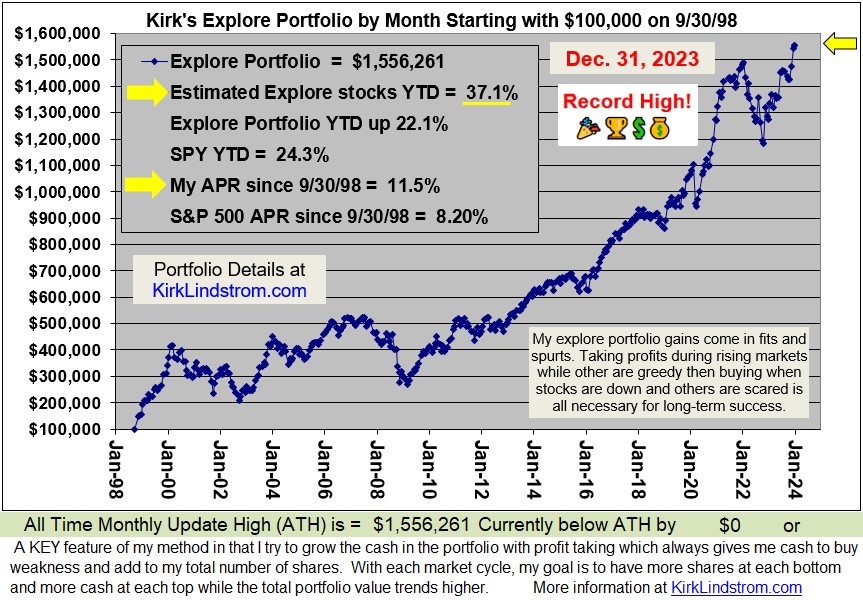
With the remaining 5 to 20% I "explore" with individual stocks where I try to beat the averages over the long term (my results) while avoiding "benchmark hugging." This means I don't expect my good and bad years to always match that of the major indexes. Higher return comes at a price of higher volatility but you can use the time of lower returns to take profits in what is up to add to what is down.
I heard John Bogle on a TV interview say he uses managed funds the same way I use and recommend my "explore portfolio."


Saturday, October 20, 2007

Warren Buffett Sold Last Shares of PetroChina Before Price Surges

Despite his reputation for "buy and hold forever," billionaire Warren Buffett said last week that his company, Berkshire Hathaway, had sold all shares of PetroChina Co. Ltd (Ticker=PTR, website), a Chinese oil conglomerate.
  • "Our Favorite holding period is forever.” -Warren Buffett
Activists had urged Buffett to sell his PetroChina shares due to the world's second largest companies ties to strife-torn Sudan via Petrochina's parent company, China National Petroleum Corp.

Click to see full size graph

Despite vocal activist shareholders in support of this divestiture, Buffett insisted in an interview on the new Fox Business Network (FBN) the decision to sell was driven by valuation.

  • "If it went down a lot I'd buy it back."

Buffett told Rupert Murdoch's FBN that the recent price gains of PetroChina's shares means he sold too soon and "left a lot of money on the table."

Buffett said Berkshire Hathaway made as much as $3.5 Billion dollars on the initial $500 million investment. As of July 2007, Berkshire Hathaway owned 11 percent of the publicly traded shares.

Berkshire bought PTR in 2003. Friday PTR closed at $232.98 after peaking at $266.81.


Friday, October 19, 2007

Elaine Garzarelli is Bullish: Indicators on a Strong Buy Signal

Today Elaine Garzarelli is very Bullish with her Indicators on a 75% Strong Buy Signal.

Elaine Garzarelli is one of the few analysts that called the 1987 bear market and got out before the crash 20 years ago today. (See 20 Years After Black Monday: October 19, 1987)

During a CNBC interview today, Elaine Garzarelli had this to say:
  • Market in '87 was 35% over valued
  • Today it is 28% under valued

Her indicators today are at 75% for a major buy signal

  • 1987 they were at 9%
  • Below 30% is a sell signal
  • Above 65% is a MAJOR buy signal

Elaine has 14 indicators in 4 areas with 25% weighting for each area. The areas are:


  • Economic Cycle: Earnings will bottom this quarter and next. Near the bottom not the top. Bullish
  • Monetary Policy: Fed is easing. Before the crash the Fed was raising rates; Bullish
  • Valuation: Market via the Fed Model is 28% under valued using her "Street low" earnings estimates. This is Bullish
  • Sentiment: Neutral hence the 75% reading.

She thinks oil is near a peak now and will come down since everything outside the US is slowing down too. But she she said the economy could handle oil going to $125 per barrell and still grow as long as it gets there slowly.


Click Graph to see it full sized

Followers - Click "follow" to get an email alert for new articles

Kirk Lindstrom's Investment Letter Performance