
John (Jack) Bogle, founder of the Vanguard Group, was just on CNBC. He is famous for saying "stay the course" and don't try to time the stock markets which he repeated. When asked if people should sell equities if they are close to retirement and are worried about future losses he said yes if it is to raise cash to get to a target bond (fixed income) allocation. Jack said he likes "something like your age in bonds" and said he is 80 and has about 80% in bonds.
I've read that many investors are either out of the market or have stopped their regular 401K contributions. I wish someone would have asked Bogle what a person who is 100% in cash should do now with the S&P500 (S&P500 Charts) under 1,000 and paying a dividend over three times larger than the 3-month Treasury bill (0.81%) and higher than the 5-Year Treasury bond now paying 2.44% (See US Treasury Rates.) (Note, I've been buying equities with buys on Monday and Tuesday this week.)
When asked what he thought about the markets, Bogle said he can't predict the future but he thinks we are more than half way through this bad period. He pointed out that eventually speculators will all get out and investors will come in when they like the value. He said in 2000 (at 1500) the S&P500 (S&P500 Charts) had a dividend yield of about 1.0% and today at 996.23 it is about 2.7%

In his 2007 book “The Little Book of Common Sense Investing” Vanguard founder John Bogle says your "serious money account" should be 50% to 100% in index funds. He says 5% of your assets can be in a "Funny Money" account. Here is some more advice from pages 202 & 203.
Individual Stocks? Yes, Pick a few. Listen to the promoters. Listen to your broker or adviser. Listen to your neighbors. Heck, even listen to your brother-in-law.
Actively managed mutual funds? Yes. But only if they are run by managers who own their own firms, who follow distinctive philosophies, and who invest for the long term, without benchmark hugging. (Don't be disappointed if the managed fund loses to the index fund in at least one year of every three!)
Closet index funds? No
Exchange Traded Funds (ETFs)? Maybe. Buy the ones that hold the classic index portfolio with your serious money account. Invest but don't speculate.
Commodity Funds? No. They don't have fundamentals like dividends or earnings to support them.
Hedge Funds? No. "Too much hype... Too much cost and too little tax efficiency."
Hedge funds-of-funds? "No. Really no." They are even more expensive than hedge funds! See my article "Insana Capital Partners Hedge Fund to Close."
Asset Allocation: On pg 208 Bogle recommends "your age in bonds" or even "your age minus 10% in bonds." Thus someone 65 years old would have 55 to 65% of their investment assets in bonds. He admits this is conservative and below what most experts advise but he is a conservative person.
Kirk's Asset Allocation Advice: I like the rule-of-thumb "120 less your age in equities." That puts someone at age 65 with 45% in bonds, 10% to 20% less than what Bogle recommends. Your equities should be a globally diversified basket of low-cost index funds such as the "core portfolios" I recommend in "Kirk Lindstrom's Investment Newsletter." For example, if you are 40 years old and don't plan to retire for 20 or more years (unless you get lucky with some of my "explore portfolio" stock picks) then you would have 80% in equities and 20% in fixed income. If you are well into critical mass, then put even less into equities and get inflation protection from TIPS since you don't need the extra "expected" return from equities at the much higher volatility (risk.)
Bogle vs. Kirk's Advice: I believe my advice is little different from Bogles advice.
I've read that many investors are either out of the market or have stopped their regular 401K contributions. I wish someone would have asked Bogle what a person who is 100% in cash should do now with the S&P500 (S&P500 Charts) under 1,000 and paying a dividend over three times larger than the 3-month Treasury bill (0.81%) and higher than the 5-Year Treasury bond now paying 2.44% (See US Treasury Rates.) (Note, I've been buying equities with buys on Monday and Tuesday this week.)
When asked what he thought about the markets, Bogle said he can't predict the future but he thinks we are more than half way through this bad period. He pointed out that eventually speculators will all get out and investors will come in when they like the value. He said in 2000 (at 1500) the S&P500 (S&P500 Charts) had a dividend yield of about 1.0% and today at 996.23 it is about 2.7%
In his 2007 book “The Little Book of Common Sense Investing” Vanguard founder John Bogle says your "serious money account" should be 50% to 100% in index funds. He says 5% of your assets can be in a "Funny Money" account. Here is some more advice from pages 202 & 203.
Individual Stocks? Yes, Pick a few. Listen to the promoters. Listen to your broker or adviser. Listen to your neighbors. Heck, even listen to your brother-in-law.
Actively managed mutual funds? Yes. But only if they are run by managers who own their own firms, who follow distinctive philosophies, and who invest for the long term, without benchmark hugging. (Don't be disappointed if the managed fund loses to the index fund in at least one year of every three!)
Closet index funds? No
Exchange Traded Funds (ETFs)? Maybe. Buy the ones that hold the classic index portfolio with your serious money account. Invest but don't speculate.
Commodity Funds? No. They don't have fundamentals like dividends or earnings to support them.
Hedge Funds? No. "Too much hype... Too much cost and too little tax efficiency."
Hedge funds-of-funds? "No. Really no." They are even more expensive than hedge funds! See my article "Insana Capital Partners Hedge Fund to Close."
Asset Allocation: On pg 208 Bogle recommends "your age in bonds" or even "your age minus 10% in bonds." Thus someone 65 years old would have 55 to 65% of their investment assets in bonds. He admits this is conservative and below what most experts advise but he is a conservative person.
Kirk's Asset Allocation Advice: I like the rule-of-thumb "120 less your age in equities." That puts someone at age 65 with 45% in bonds, 10% to 20% less than what Bogle recommends. Your equities should be a globally diversified basket of low-cost index funds such as the "core portfolios" I recommend in "Kirk Lindstrom's Investment Newsletter." For example, if you are 40 years old and don't plan to retire for 20 or more years (unless you get lucky with some of my "explore portfolio" stock picks) then you would have 80% in equities and 20% in fixed income. If you are well into critical mass, then put even less into equities and get inflation protection from TIPS since you don't need the extra "expected" return from equities at the much higher volatility (risk.)
Bogle vs. Kirk's Advice: I believe my advice is little different from Bogles advice.
- Bogle says you can have up to 50% of your portfolio in managed funds, up to 5% in a "Funny Money account" and the rest should be in index funds. He is clear he thinks the index funds will do the best overall and would be happy with 100% in index funds for both equities and bonds.
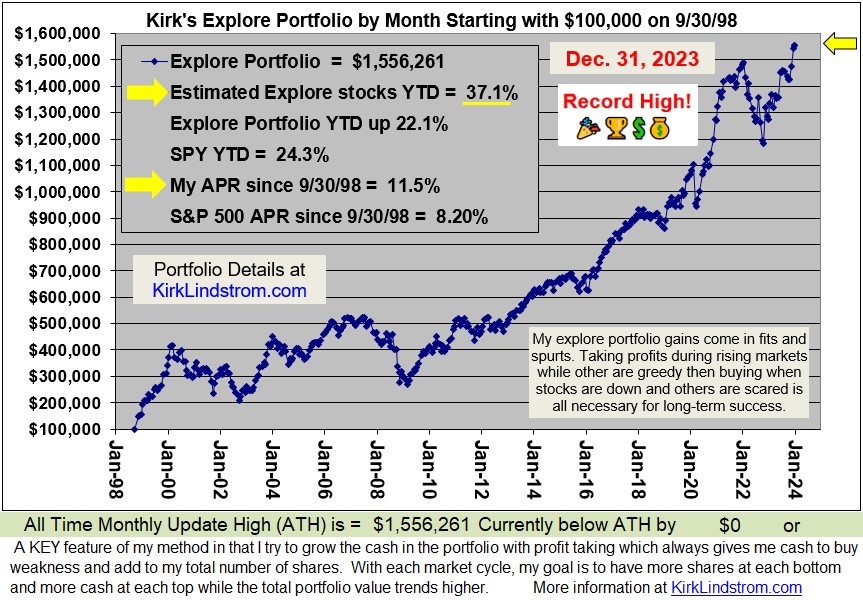
- I believe my "explore portfolio," if followed exactly, is no different than investing in a managed mutual fund but I only recommend it for 5 to 20% of your investment assets. My recommended core portfolios are 100% globally diversified index funds. I recommend my core portfolios for 80% to 95% of your investment assets.
If you want to know what I have been buying in this period of weakness with my profit taking dollars from selling when the market was higher, Subscribe to Kirk's Investment Newsletter TODAY and get the October 2008 Issue for FREE!



 Posts
Posts


 kirklindstrom.com
