
In this video interview John (Jack) Bogle, the founder and former chairman of Vanguard, gives his current recommends for bond investors. Many will be surprised to learn Bogle is recommending against holding certain types of bonds and a different bond allocation than what is in Vanguard's Total Bond Index Fund, VBMFX.
For most of his career, Bogle has recommended against market timing in favor of placing your assets into index funds with an allocation based on your age. Generally, he recommended 100 percent less your age into Vanguard's Total Stock Market index fund, VTSMX, with the remainder of the funds in Vanguard's Total Bond Index Fund as he said in a CNBC interview.
Get your balance right. Have a certain amount in bond funds, bond index funds or Pimco funds for that matter because Paul (McCulley, PICMCO managing director) has done a fabulous job out there. Paul and Bill (Gross, PIMCO Founder and director). Take your equity position and make it 80% say US, 20% non US. Get your balance having something to do with your age. More bonds as you get older like I am and stay the course.
[John C. Bogle (7/14/08 with DJIA in a bear market at 11,100)]
This has changed which the video below and my summary of the interview highlight.
Some Key points from the interview:
#1 Bogle says avoid the long maturities:
I am nervous about the fixed income markets. Therefore I would not use the long maturities.#2 Bogle recommends about 1/2 short term bonds and 1/2 in intermediate term to get some "reasonable income" and the ability to "ride the fluctuations that are sure to come."
And so, I'd say some combination of maybe one half short term bonds, or limited term, a little longer than short term, or in intermediate terms. In other words, half in short and limited, and half in intermediate term, which should give you some reasonable income, and should enable you to ride with these fluctuations that are sure to come, I think, in the bond market.===================================================
===================================================
Full Text of Bogle Interview.
#3 On the total bond index fund, VBMFX, Bogle recommends a different weighting with more in corporate and less in government bonds than the index shows.
So you really ought to look into what kind of a bond fund you have. The index has sort of an intermediate term of maturity, and that's certainly more than satisfactory. But it's heavily weighted by government, and at these yield relationships, I'd think I'd have a little more in corporates, and maybe a little less in governments, than the index shows.
Some will say the above is market timing which Bogle has been a strong opponent against.
The idea that a bell rings to signal when investors should get into or out of the stock market is simply not credible. After nearly fifty years in this business, I do not know of anybody who has done it successfully and consistently. I don't even know anybody who knows anybody who has done it successfully and consistently. Yet market timing appears to be increasingly embraced by mutual fund investors and the professional managers of fund portfolios alike.
[John C. Bogle in Common Sense on Mutual Funds: , pg 20]
My answer is Bogle has recommended against market timing the stock market in general but he's always said it is ok to use some of your "mad money" or "explore portfolio" to gamble on the edges. Bogle on Managed Mutual Funds:
“Actively managed mutual funds? Yes. But only if they are run by managers who own their own firms, who follow distinctive philosophies, and who invest for the long term, without benchmark hugging. (Don't be disappointed if the managed fund loses to the index fund in at least one year of every three!)"
[John C. Bogle in “The Little Book of Common Sense Investing”, Chapter 18]
Bogle on individual stocks for your “Funny Money” account:
“Yes, Pick a few. Listen to the promoters. Listen to your broker or adviser. Listen to your neighbors. Heck, even listen to your brother-in-law.”
[John C. Bogle in “The Little Book of Common Sense Investing”, pg 202]
Also, removing long term and some government bonds from your portfolio and replacing them with corporate bonds doesn't change your allocation between fixed and equities so you could argue he isn't market timing stock, just bonds!
I agree with Bogle's advice and neither of my newsletter portfolios currently have bonds with long maturities. Kirk's Two Investment Letters
With my own money and the core portfolios in "Kirk Lindstrom's Investment Letter," I don't need the yield so I am in capital preservation mode on the fixed income side with my only bonds holdings in iBonds, TIPS and TIPS index funds such as FINPX from Fidelity and VIPSX from Vanguard.
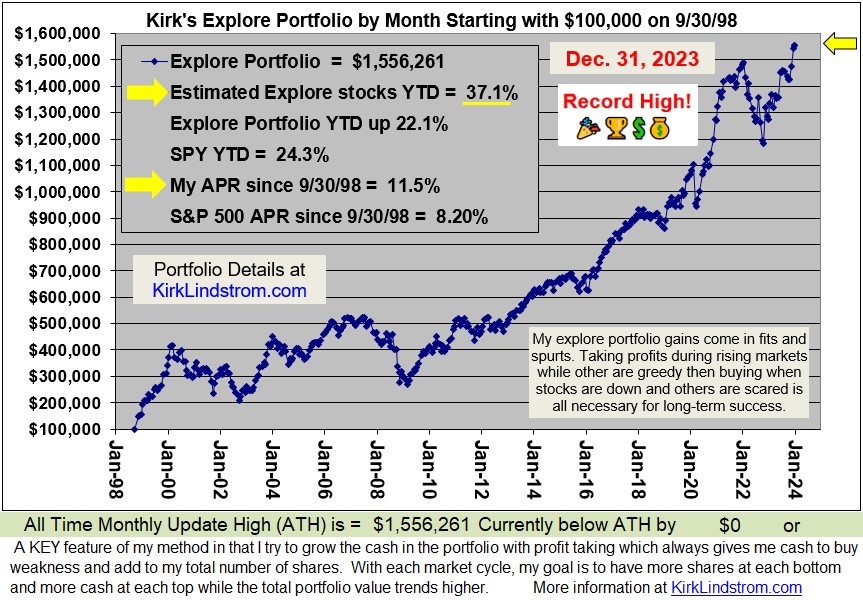
Since 12/31/98 "Kirk's Newsletter Explore Portfolio" is UP 158% (a double plus another 58%!!) vs. the S&P500 UP a tiny 4.5% vs. NASDAQ UP a tiny 1.2% (All through 6/5/10 )
In 2009, "Kirk's Newsletter Explore Portfolio" gained 33.5% vs. the DJIA up 18.8%
More Information:
- Free Sample of "Kirk Lindstrom's Investment Letter"
- iBonds: Current Series I Bond Rates
- Vanguard's TIPS Fund VIPSX
- VTSMX Charts and Quote
- VBMFX Charts and Quote
What do people think about John Bogle's advice to not own certain bonds and have a different bond allocation than is currently in the total bond fund?



 Posts
Posts


 kirklindstrom.com
