Don't Miss Out On Great Gains! - Best Investment Newsletter


Click for FREE sample of Kirk Lindstrom's Investment Letter

Don't miss out! Subscribe Now

google.com, pub-7001134751860982, DIRECT, f08c47fec0942fa0

Search For More

Showing posts with label Vanguard. Show all posts

Wednesday, June 08, 2016

Vanguard Retirement Advice vs. Kirk's Newsletter: A Testimonial

All of the core funds in my newsletter are low cost index funds from Vanguard.  
Currently I recommend six different funds for both my "Aggressive Core Portfolio" and my "Conservative Core Portfolio."  Here is an email I got out of the blue from a subscriber who has been with me for many years and gave me permission to use his note.
On 6/6/2016 5:14 PM, Tom H. wrote:
Hi Kirk,
   I thought I would share a conversation with a Vanguard advisor on Friday and for the first time ever I felt like I was being sold.  They “offered” a service that has a name which I can’t recall but basically they would advise and monitor and discuss with me on a quarterly basis my investment portfolio.  I’m sure they would be helpful but for a guy who has mostly done all his own homework or more recently relied on your newsletter it felt like a lot of $.  I believe the cost is .30 or $3,000 per million annually.  On a percentage basis it doesn’t sound like a lot but compared to your newsletter and a long time investor who has gained a lot of knowledge I felt sticker shocked.  I guess what I’m saying is your newsletter is a bargain 
    I’d also like to ask why you don’t just throw all your international into the total international stock rather than sector it. ......  Thanks.
Tom
Kirk Lindstrom's Investment Letter:


Wednesday, October 06, 2010

Vanguard Lowers Admiral Shares Minimum to $10,000

Vanguard Lowered Admiral Shares Minimum to $10,000 for Index Funds and $50,000 for Managed Funds.

This is great news for Vanguard investors, especially those who follow my core portfolios made of Vanguard Index funds.  Vanguard says:
"If any of your current Vanguard fund holdings qualify, we'll notify you by mail and provide additional details about what this change means for you. Then, over the next few weeks, we'll complete the change for you automatically."
I called Vanguard and immediately converted my accounts that were under $100,000 and qualified to the lower cost funds.  The gentleman I spoke to was not aware of the change and thanked me for alerting him.   They said they plan to convert accounts automatically but you can call or do it yourself online. 

Subscribe NOW and get the October 2010 Issue of "Kirk Lindstrom's Investment Letter" for FREE!
(Your 1 year, 12 issue subscription will start with next month's issue.)
Key Points:
  • Effective today, Vanguard has reduced the minimum amount required to qualify for Admiral™ Shares to $10,000 for most of our broad-market index funds and $50,000 for actively managed funds, down from the previous $100,000 minimum. Admiral Shares cost significantly less than traditional fund shares, and their expense ratios are among the lowest in the mutual fund marketplace.
  • Thanks to their low costs, Admiral Shares can reduce your expenses 18%–50% below the already low expense ratios of our standard Investor Shares. For example, if you invest $50,000 in a fund's Admiral Shares with a 0.07% expense ratio instead of its Investor Shares with a 0.18% expense ratio, you could keep approximately $1,200 more in net returns for your account over a 10-year period, assuming an average annual return of 8%.
Switching to Admiral Shares is easy:
  • When you're promoted to Admiral Shares, you'll remain invested in the same Vanguard fund(s). Admiral Shares are just lower-expense shares of existing funds.
  • All cost-basis information from your Investor Shares will be transferred to your Admiral Shares automatically.
  • Changes from Investor Shares to Admiral Shares of the same fund are tax-free.
  • Any check writing privileges you had with your Investor Shares account will transfer to your Admiral Shares account. You'll receive a new checkbook for your Admiral Shares account.
Vanguard Fund Comparison
Name and (Ticker Symbol) Min Initial Investment Total Expense Ratio Annual Cost per $10,000


Vanguard 500 Index Investor (VFINX) $3,000 0.18% $18.00
Vanguard 500 Index Admiral (VFIAX) $10,000 0.07% $7.00
SPDR S&P 500 (SPY) none 0.09% $9.00


Vanguard Total Stock Mkt Idx (VTSMX) $3,000 0.18% $18.00
Vanguard Total Stock Mkt Idx Adm (VTSAX) $10,000 0.07% $7.00
Vanguard Total Stock Market ETF (VTI) none 0.07% $7.00
 
My core portfolios are made of Vanguard index funds and a CD. This great news means all funds become Admiral shares where they get the lower expense ratios to keep even more money in my portfolios!

1/1/1999 through 09/30/10
Total return - and - Compound annual return

My "50:50 Conservative Core Portfolio" was up 75.3% or 4.9% compound annual return.
==> $100,000 invested 1/1/99 became $175,279
==> 50:50 means half in equities and half in fixed income
My "80:20 Aggressive Core Portfolio" was up 62.2% or 4.2% compound annual return.
==> $100,000 invested 1/1/99 became $162,159
My "70:30 Explore Portfolio" was up 170.2% or 8.8% compound annual return.
==> $100,000 invested 1/1/99 became $270,186
=================================================
80% in “Core Aggressive” plus 20% in “Explore” was up 88.1% or 5.5% compound annual return.
==> $100,000 invested 1/1/99 became $188,053
95% “Core Conservative” plus 5% “Explore” was up 82.8% or 5.3% compound annual return.
==> $100,000 invested 1/1/99 became $182,831
100% in VTSMX was up 27.5% or 2.1% compound annual return.
==> $100,000 invested 1/1/99 became $127,508
VFINX (S&P500) was up 14.4% or 1.1% compound annual return.
==> $100,000 invested 1/1/99 became $114,372
Vanguard's Money Market Fund was up 41.4% or 3.0% compound annual return.
==> $100,000 invested 1/1/99 became $141,393


In 2009, "Kirk's Newsletter Explore Portfolio" gained 33.5% vs. the DJIA up 18.8%
2010 YTD the "Explore Portfolio" is up 4.8% YTD
 
Subscribe NOW and get the October 2010 Issue for FREE!
(Your 1 year, 12 issue subscription will start with next month's issue.)


Here is the full announcement from Vanguard:

Sunday, June 06, 2010

John Bogle on Long, Government & Corporate Bonds

Summary of John Bogles advice given during a video interview on bond allocation to Long, Government and Corporate Bonds.

In this video interview John (Jack) Bogle, the founder and former chairman of Vanguard, gives his current recommends for bond investors. Many will be surprised to learn Bogle is recommending against holding certain types of bonds and a different bond allocation than what is in Vanguard's Total Bond Index Fund, VBMFX.

For most of his career, Bogle has recommended against market timing in favor of placing your assets into index funds with an allocation based on your age. Generally, he recommended 100 percent less your age into Vanguard's Total Stock Market index fund, VTSMX, with the remainder of the funds in Vanguard's Total Bond Index Fund as he said in a CNBC interview.
Get your balance right. Have a certain amount in bond funds, bond index funds or Pimco funds for that matter because Paul (McCulley, PICMCO managing director) has done a fabulous job out there. Paul and Bill (Gross, PIMCO Founder and director). Take your equity position and make it 80% say US, 20% non US. Get your balance having something to do with your age. More bonds as you get older like I am and stay the course.
[John C. Bogle (7/14/08 with DJIA in a bear market at 11,100)]

This has changed which the video below and my summary of the interview highlight.

Some Key points from the interview:

#1 Bogle says avoid the long maturities:
I am nervous about the fixed income markets. Therefore I would not use the long maturities.
#2 Bogle recommends about 1/2 short term bonds and 1/2 in intermediate term to get some "reasonable income" and the ability to "ride the fluctuations that are sure to come."
And so, I'd say some combination of maybe one half short term bonds, or limited term, a little longer than short term, or in intermediate terms. In other words, half in short and limited, and half in intermediate term, which should give you some reasonable income, and should enable you to ride with these fluctuations that are sure to come, I think, in the bond market.
===================================================

===================================================
Full Text of Bogle Interview.

#3 On the total bond index fund, VBMFX, Bogle recommends a different weighting with more in corporate and less in government bonds than the index shows.
So you really ought to look into what kind of a bond fund you have. The index has sort of an intermediate term of maturity, and that's certainly more than satisfactory. But it's heavily weighted by government, and at these yield relationships, I'd think I'd have a little more in corporates, and maybe a little less in governments, than the index shows.

Some will say the above is market timing which Bogle has been a strong opponent against.
The idea that a bell rings to signal when investors should get into or out of the stock market is simply not credible. After nearly fifty years in this business, I do not know of anybody who has done it successfully and consistently. I don't even know anybody who knows anybody who has done it successfully and consistently. Yet market timing appears to be increasingly embraced by mutual fund investors and the professional managers of fund portfolios alike.
[John C. Bogle in Common Sense on Mutual Funds: , pg 20]

My answer is Bogle has recommended against market timing the stock market in general but he's always said it is ok to use some of your "mad money" or "explore portfolio" to gamble on the edges. Bogle on Managed Mutual Funds:
Actively managed mutual funds? Yes. But only if they are run by managers who own their own firms, who follow distinctive philosophies, and who invest for the long term, without benchmark hugging. (Don't be disappointed if the managed fund loses to the index fund in at least one year of every three!)"
[John C. Bogle in “The Little Book of Common Sense Investing”, Chapter 18]

Bogle on individual stocks for your “Funny Money” account:
Yes, Pick a few. Listen to the promoters. Listen to your broker or adviser. Listen to your neighbors. Heck, even listen to your brother-in-law.
[John C. Bogle in “The Little Book of Common Sense Investing”, pg 202]

Also, removing  long term  and some government bonds from your portfolio and replacing them with corporate bonds doesn't change your allocation between fixed and equities so you could argue he isn't market timing stock, just bonds!

I agree with Bogle's advice and neither of my newsletter portfolios currently have bonds with long maturities.  Kirk's Two Investment Letters

With my own money and the core portfolios in "Kirk Lindstrom's Investment Letter," I don't need the yield so I am in capital preservation mode on the fixed income side with my only bonds holdings in  iBonds, TIPS and TIPS index funds such as FINPX from Fidelity and VIPSX from Vanguard.

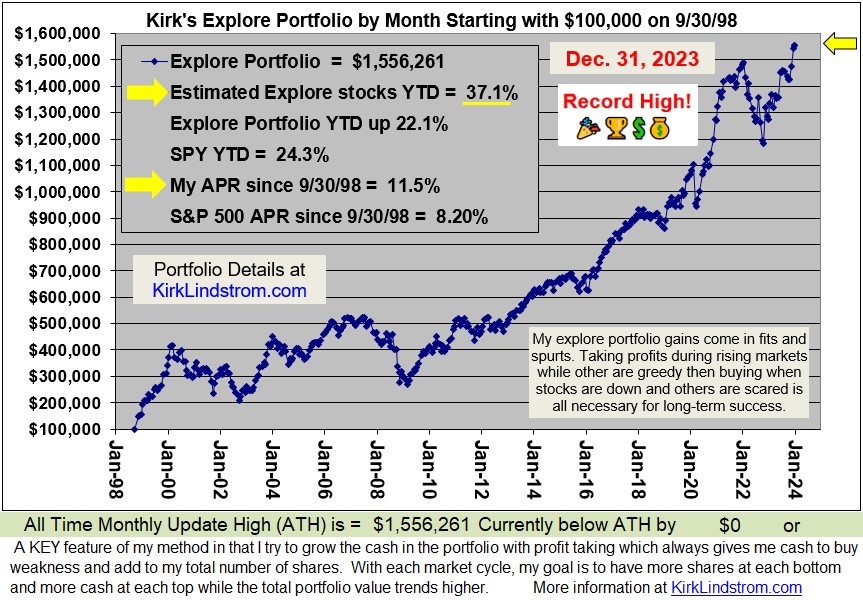
Since 12/31/98 "Kirk's Newsletter Explore Portfolio" is UP 158% (a double plus another 58%!!) vs. the S&P500 UP a tiny 4.5% vs. NASDAQ UP a tiny 1.2% (All through 6/5/10)

In 2009, "Kirk's Newsletter Explore Portfolio" gained 33.5% vs. the DJIA up 18.8%
Subscribe NOW and get the June (or the current month) Issue for FREE!  
More Information:

What do people think about John Bogle's advice to not own certain bonds and have a different bond allocation than is currently in the total bond fund?   


Thursday, June 04, 2009

Vanguard Treasury Money Market Funds to Merge After Closing to New Accounts

To preserve competitive yields in its money market funds, Vanguard will merge its Vanguard Admiral Treasury Money Market Fund (VUSXX) and Vanguard Treasury Money Market Fund (VMPXX).
To protect current shareholders from dilution of yield that comes from new deposits, Vanguard also closed its "Vanguard Federal Money Market Fund" on June 2. The decision to close the fund was made "to protect the interests of current fund shareholders by limiting the fund's need to purchase new short-term federal agency securities that offer negligible yields."
The merger of Vanguard Treasury Money Market Fund, which has an expense ratio of 0.28%, into Admiral Treasury Money Market Fund, with its lower expense ratio of 0.15%, will reduce expenses for Treasury fund shareholders. After the merger, the fund is expected to maintain its expense ratio of 0.15%. Additionally, reducing new cash flow into the Vanguard Federal Money Market Fund may slow the decline of that fund's yield.
For similar reasons, Vanguard Admiral Treasury Money Market Fund and Vanguard Treasury Money Market Fund were closed to new accounts on January 26, 2009.

Vanguard Admiral Treasury Money Market Fund (VUSXX)
Closed to new investors
Category = Taxable Money Market
Expense ratio as of 12/29/2008 = 0.15%
SEC yield as of 06/03/2009 = 0.18%
Vanguard Treasury Money Market Fund (VMPXX)
Closed to new investors
Category = Taxable Money Market
Expense ratio as of 12/29/2008 = 0.28%
SEC yield as of 06/03/2009 = 0.05%
Vanguard Federal Money Market Fund (VMFXX)
Closed to new investors
Category = Taxable Money Market
Expense ratio as of 12/29/2008 = 0.28%
SEC yield as of 06/03/2009 = 0.34%
If you have less than a few million dollars to invest, I would look to invest in 6 month to 2 year CDs to get much better yield with FDIC and NCUA protection spread between several banks and credit unions.

For example, the 1-year US Treasury note is only paying 0.46% but you can get a 1-year CD at Ally Bank (formerly GMAC Bank) that pays 2.80%.

See "Very Best CD Rate Survey" to get an idea what the best CD rates are for terms from 6 months to 10 years.

More Information:

Charts for Vanguard Equity Index Funds:
Charts for Vanguard Fixed Income Funds:
Money Market Fund Pages at Vanguard:
Read the full story: With yields at record lows, Vanguard announces changes to three money market funds

Monday, September 10, 2007

Allan Coleman on Vanguard High Yield Fund

Allan Coleman likes Vanguard's High Yield Fund ( a "junk bond" fund with ticker symbol VWEAX ) at $6.00.

Posted on our Facebook Forum by Allan Coleman:

September 10, 2007: As expected , the navs of our favorite Vanguard GNMA funds ( VFIIX & VFIJX ) went UP to $10.26 today .

Observations:

  • VFIJX = 4.28% ytd with a 5.24% yield
  • $404k of GNMAs purchased at an average price of $9.95 since June 22nd of 2006 is now worth $426,710.36
  • VMMXX = 3.60% ytd with a 5.09% yield
    On my radar screen is the Vanguard High - Yield ( junk ) bond fund ( VWEAX ) that closed UNCHANGED today at $5.96 a share that I'm waiting to either break through the 50 day moving average and show a turn to the upside or to decline to a lower price .
    Either way , I feel a purchase price below $6.00 a share is a good value .
    Especially IF the Fed cuts rates next week .
VWEAX Prices

DateClose
10-Sep-075.96
7-Sep-075.96
6-Sep-075.96

Chart of Vanguard's High Yield (Junk bond) Fund
more VWEAX charts

(Unlike Allan Coleman, I, Kirk, never liked or recommended this fund. I prefer "explore portfolio" stocks for this sort of risk where your upside is unlimited with the same downside risk of the company going out of business.)

More information:

Request Invitation to our facebook discussion group

Followers - Click "follow" to get an email alert for new articles

Kirk Lindstrom's Investment Letter Performance