Don't Miss Out On Great Gains! - Best Investment Newsletter


Click for FREE sample of Kirk Lindstrom's Investment Letter

Don't miss out! Subscribe Now

google.com, pub-7001134751860982, DIRECT, f08c47fec0942fa0

Search For More

Showing posts with label ECRI Cyclical Outlook. Show all posts

Tuesday, July 30, 2013

ECRI's Lakshman Achuthan Defends their Recession Call

July 30 (Bloomberg) -- Lakshman Achuthan, co-founder of the Economic Cycle Research Institute, talks about the U.S. economy. Achuthan speaks with Tom Keene and Sara Eisen on Bloomberg Television's "Surveillance." (Source: Bloomberg)
----------------------------------------------------------------

----------------------------------------------------------------

Highlights:
  • Job losses for 35 to 54 year olds are approaching one million jobs lost since this "recovery" began.  This is where you make and spend the most money and is at the core to what is wrong. 
  • If you are doing well, then in the recent economy you are doing very well.  If you are near Wall Street, then "it is good to be close to the helicopters which are spewing cash."
  • The Fed would "not have four years of zero interest rate policy and quantitative easing forever and Q-ternity if everything was OK."
  • "We believe a recession began last year."
  • "Sometimes it takes up to two years" for final GDP revisions which can be large.
  • Past downward revisions to GDP were 2 to 4 percentage points lower after the last few recessions.
  • The Fed is using "trickle down theory" of the "wealth effect" hoping higher stock and housing prices will stimulate the economy.
  • The pace of growth in home prices will decelerate. 
  • The current GDP data shows US growth is lower now than in Japan during their "lost decades."
Feel free to add any items I missed or you think is important in the comments.
Facebook Group "Investing for the Long Term"

Tuesday, April 30, 2013

Q1 GDP & ECRI Clarification on Recession Call

On April 26, 2013, US Bureau of Economic Analysis released its first estimate of real gross domestic product, GDP.
Real gross domestic product -- the output of goods and services produced by labor and property located in the United States -- increased at an annual rate of 2.5 percent in the first quarter of 2013 (that is, from the fourth quarter to the first quarter), according to the "advance" estimate released by the Bureau of Economic Analysis. In the fourth quarter, real GDP increased 0.4 percent. 
The Bureau emphasized that the first-quarter advance estimate released today is based on source data that are incomplete or subject to further revision by the source agency (see the box on page 3 and "Comparisons of Revisions to GDP" on page 5). The "second" estimate for the first quarter, based on more complete data, will be released on May 30, 2013. 
The increase in real GDP in the first quarter primarily reflected positive contributions from
personal consumption expenditures (PCE), private inventory investment, exports, residential investment, and nonresidential fixed investment that were partly offset by negative contributions from federal government spending and state and local government spending. Imports, which are a subtraction in the calculation of GDP, increased.
We had a good discussion of this release in my "Investing for the Long Term" Facebook group where many questioned how could ECRI think we are in a recession with 2.5% GDP growth.

 Lakshman Achuthan from ECRI posted the following comments:  (Text follows image)

Text for my articles


Lakshman Achuthan You're not alone in thinking our recession call was wrong. Still, the facts are that the GDP release on August 28, 2008 – with the economy eight months inside the Great Recession – revised Q2/08 GDP growth to 3.3% from 1.9%, up from 0.9% in Q1/08. But both of those data points, as well as GDP data for the first two quarters of the 2001 and 1990-91 recessions, were subsequently revised by 2 to 4 percentage points over time. This is how real-time data often behave during recessions.

Lakshman Achuthan Hardly any economists recognized the severe 1973-75 recession until almost a year after it started. Indeed, that recession began with the ISM at 68.1, and payroll jobs growth did not turn negative for eight months.

In 1970, unaware that the economy was nine months into recession, none other than Paul Samuelson said that the NBER had worked itself out of a job, meaning that improved policy expertise had made recessions very unlikely. http://www.businesscycle.com/ecri-news-events/news-details/economic-cycle-research-the-2012-recession-are-we-there-yet


www.businesscycle.com
Nine months ago we knew that, sitting here today, most people probably would not realize that we are in recession – and we do believe we are in recession.

Lakshman Achuthan Just to clarify, a recession is not defined by two successive quarters of negative GDP, rather it's a self-reinforcing downturn in economic activity, when a drop in spending leads to cutbacks in production and thus jobs, triggering a loss of income that spreads across the country and from industry to industry, hurting sales and in turn feeding back into a further drop in production - in effect a vicious cycle. 
http://money.cnn.com/2008/05/05/news/economy/recession/


money.cnn.com
Recession? Or just a slowdown? Some will tell you it doesn't much matter - that it's a distinction without a difference. Nothing could be further from the truth - or as dangerous a delusion.


Monday, November 07, 2011

ECRI Still Forecasts A Recession

Unimpressed with Current Economic Data, ECRI Still Forecasts A Recession 

The Economic Cycle Research Institute, a New York-based independent forecasting group also know as ECRI, continues to see a US recession in our future.  Even after a large rebound for the stock market with coincident economic data coming in better than expected, Lakshman Achuthan, ECRI's managing director, is not impressed. (More about ECRI)
Achuthan says economists on the Street are only “now-casting” which is not the proper way to forecast recessions. Lakshman said that on average “it is about six months inside of the recession that people realize there’s a recession”.  ECRI is still forecasting a recession as he sees “contagion among forward looking indicators.” 
"A lot of people are happy with GDP numbers" but "in the past century the vast majority of all recessions have begun in a quarter that showed positive GDP growth."
Watch his full CNBC interview here:
 

Read ECRI's Recession Call at:
I took profits near the highs this year and raised a lot of cash.  Then I put that cash to work near the lows for the year.  Then the market rallied and I sold a good deal of what I bought during the market weakness so I'm ready to do it again yet will profit nicely if the market goes higher.  Here are what some of my subscribers sent me via email recently:
  • Oct 28, 2011:  Steve P: Kirk, just want to say you had a great batch of sell actions last week.  Many of the financial threads I follow were saying a buy is in in their weekend notes.  Yet you were selling.  Good job.
  • 10/27/2011:  Bard P:  YES, I love those newsletters, and will renew by PayPal.  Thanks for all that Mad Money :)
  • 10/24/2011:  Patrick O:  Love your  newsletter...
  • 9/26/11: Barbara H: Yes, another year of your insightful newsletter.  Check is in the mail.
 
  Learn the "Core and Explore" approach to investing
with "Kirk Lindstrom's Investment Letter"


Subscribe NOW and get the November 2011 Issue for FREE!  
(Your 1 year, 12 issue subscription will start with next month's issue.)
  • Get email alerts when I buy or sell securities for my explore portfolio
  • "Auto Buy" and "Auto Sell" levels set ahead of time for target buy and sell levels for my securities.  This allows you to place "limit orders" with your broker in advance so you can go about your business.
  • All questions about what I write answered by Email.  If what I write is not clear to you, just ask!

Friday, September 30, 2011

ECRI says Jobs To Get Worse Under Recession-Bound U.S. Economy

The Economic Cycle Research Institute, ECRI - a New York-based independent forecasting group, released its latest readings for its proprietary Weekly Leading Index (WLI) today. (More about ECRI)

From
ECRI's Weekly Leading Index Falls: Jobs To Get Worse Under Recession-Bound U.S. Economy
  • ECRI’s recession call isn’t based on just one or two leading indexes, but on dozens of specialized leading indexes, including the U.S. Long Leading Index, which was the first to turn down – before the Arab Spring and Japanese earthquake – to be followed by downturns in the Weekly Leading Index and other shorter-leading indexes.
  • ...the most reliable forward-looking indicators are now collectively behaving as they did on the cusp of full-blown recessions, not “soft landings.”
  • "if you think this is a bad economy, you haven’t seen anything yet."
For a better understanding of ECRI's indicators, read its book, "Beating the Business Cycle."
Book: Beating The Business Cycle
Click book to order
..

Tuesday, September 27, 2011

ECRI Recession Call

The Economic Cycle Research Institute, a New York-based independent forecasting group known as ECRI, called for a recession. (More about ECRI

 Here is what the International Business Times reported this mornng in a summary called "6 Signs We are in a Global Recession."
Stagnation may be an overly positive term. The Economic Cycle Research Institute in mid-September entitled its U.S. cyclical outlook "Economy on Recession Track."
Here's an excerpt from the report: "Today, we must sound the alarm bells loud and clear. ECRI's leading indices of U.S. economic activity have turned down in a textbook sequence. The recessinoary decline in a summary measure of numerous reliable leading indicators, coupled with an ominous drop in a broad measure of current ecnoomic activity representing facts, not forecasts, constitutes a compelling recession signal."
A recession seems baked into the cake already. We were at 1.0% GDP growth before the European PIIGS mess and then we got the double whammy of the dysfunctional congress kicking the deficit issue can down the road. Either of those "black swans" could be enough to kick the economy into a recession on their own but together they probably sealed the deal.

OK, lets assume we are currently in a recession. Is it a big one like the last one or a short, small one? The markets corrected roughly 20% off their highs this year. Is that enough pullback for a small recession?

The next question: Is this a short lived recession that was predicted already by the leading tech stocks already going down from a peak early this year? The market may have bottomed in August and could be on the way up to pull us out of a recession before the numbers even indicate one happened.

How would we know? The only way I know is to keep an eye on ECRI's leading indicators.

Sunday, August 21, 2011

ECRI Can Not Rule Out 2012 Recession

In this July 29, 2011 video interview ECRI's (The Economic Cycle Research Institute) Lakshman Achuthan says the business cycle slowdown they predicted while others were calling for a second half recovery "persists through year-end.”   
VIDEO
ECRI has not called for a recession but we do have a slowdown that makes the market more susceptible to a shock that can push the economy into a recession. Thus, they cannot rule out a 2012 recession.
Click to order
Book: Beating The Business Cycle
..

Tuesday, November 30, 2010

ECRI Calls for Revival of US Economic Growth

The Economic Cycle Research Institute, ECRI - a New York-based independent forecasting group, upgraded their projection for future economic growth. (More about ECRI)  ECRI's managing director and cofounder, Lakshman Achuthan, was on CNBC yesterday to discuss their upgrade of their Oct 28, 2010 prediction "The much-feared double-dip recession is not going to happen"  to "There will be a revival of US Economic growth in the near future."   
In this interview, Achuthan says the the recovery is persistent. If you have read their book, Beating the Business Cycle, you know the WLI indicators must be persistent, pronounced and pervasive before ECRI will call for a turn in the US economy.  The best news is once they declare an upturn, it means there is some margin for economic shocks.  The US economic recovery is not as "fragile" now as it was a few months ago when the WLI was flat.
Some key paraphrased points from the interview:
  • "We are able to say with a lot of conviction, that there is a revival in growth right ahead of us."
  • Our economic longest leading indicators are "locked on" a "soft landing track."
  • "When you are at this stage of the cycle, a shock won't derail us and put us into a new recession."
Click to see full size Image
    • "When you are at this stage of the cycle, a shock won't derail us and put us into a new recession."
    • Almost impossible to jump to a recession track.
    • This is telling us we will see a revival in US economic growth despite numerous headwinds including the current trouble in Europe.
    • In October they said "no second recession."  Now they are saying economic growth COULD grow to 3 or 4% rather than drop to 1 to 2% from the current 2.5% GDP Growth rate.
    • Unemployment: We lost 8.5 million jobs and have made back one million so we're about 7.5 million in the hole.  Even if things go great and we gain another million jobs we'd still be down 6.5 million so we "won't feel great."
    Video: Positive news for investors, with Lakshman Acuthan, Economic Cycle Research Institute.

    Airtime: Tues. Nov. 30 2010 | 3:16 AM ET

    KEY ECRI Articles:


    Thursday, March 04, 2010

    ECRI Says No Recession This Year, But Recessions Will Be More Frequent so Buy and Hold is Dead

    Lakshman Achuthan, the Managing Director at the Economic Cycle Research Institute (More about ECRI) says that the current recovery is the Rodney Dangerfield of recoveries — it’s not getting any respect. He also predicts more frequent recessions than in past years, but no recession this year.
    =========================================

    =========================================
    Buy and Hold is dead:
    "Buy and Hold is dead because if you have frequent recessions, that means you have downturns in the market and buying and holding is a real bad strategy."
    GDP Growth Rate:
    We are going to have an "easing in growth by mid year."
    This means we won't keep growing at 5.9% but the economy will keep growing so no recession, at least for this year (2010.)

    More information:

    US Treasury: Rate Quotes


    Thursday, December 31, 2009

    ECRI's 2010 Cyclical Outlook

    The Economic Cycle Research Institute's (ECRI) managing director, Lakshman Achuthan, appeared on CNBC’s Squawk Box this morning to discuss ECRI's near-term and longer-term cyclical outlook. His comments come at the beginning and end of the video segment and are summarized in text below the video.
    ========================================================================================

    Summary of ECRI's Key Points:
    • No "double dip" recession
    • “chronically high” jobless rates
    • Clear sailing for first half of 2010
    • Global slowdown in 2h 2010
    • Recessions in next decade will be more frequent.
    • Duration of expansions will be shorter than we are used to
    Lakshman was also a guest on Bloomberg TV where he said "buy and hold is dead" due to the frequent recession and recovery cycles. Of course, "core and explore" asset allocation strategies such as mine should prosper in this environment as we take profits when up and buy back when down. For details on how to prosper during a cyclical market that is volatile but goes nowhere, see my article:
    Lakshman's summary comments via email:
    • No "new normal" of slow and steady growth! Rather, more frequent recessions ahead A la Japan, 4 recessions in 17 yrs with average expansion less than 3 years.
    • Such an environment is bad for "buy and hold," mentality, but navigable with good leading indexes
    • Frequent recessions = little chance of jobless rate falling back to 2007 lows for many years, maybe decades
    • Key question in investors' minds today is Fed policy timing. The answer will be determined by timing of next downturn. ECRI's leading indexes are designed to anticipate this.
    • Today too soon to tell, but mark my words, there is always another turning points out there, and my guess is we’ll be seeing more of them than we’ve become accustomed to in recent decades.
    More information:

    Followers - Click "follow" to get an email alert for new articles

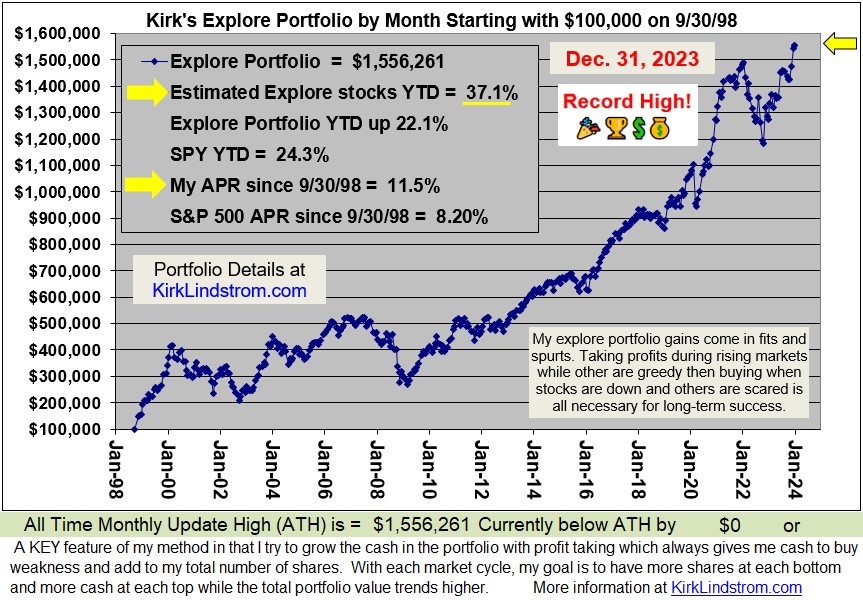
    Kirk Lindstrom's Investment Letter Performance